Showing posts with label Ozu. Show all posts

Tuesday, January 25, 2022

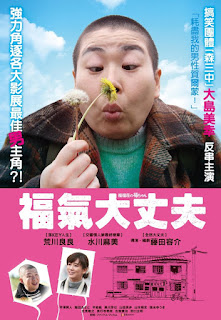
Fuku-Chan of Fukufuku Flats [dir. Yosuke Fujita]

Yosuke Fujita's movie Fuku-chan of Fukufuku Flats seemed like it could be an interesting entry in the laidback whimsical movie mold, like Katsuhito Ishii's The Taste of Tea, which I enjoyed a lot. The story revolves around Fuku-chan aka Fukuda (Miyuki Oshima), a shy and pudgy bachelor that lives in a blue-collar apartment complex and makes a living as a wall painter. Fukuda's single status is worrying his closest friend Shimacchi (Yoshiyoshi Arakawa) who keeps trying to arrange matches for him. These attempts are firmly rebuffed by Fukuda, otherwise an easy-going and good-natured person that quickly makes friends, even with decided oddballs like the neighbor with a python and another who is constantly visiting shrines as penitence for having once been a panty-stealer.

One day Fukuda meets the woman Chiho (Asami Mizukawa) who in the past had done him a wrong that scarred him for life, but is now determined to make amends for her mistake. The rest of the film is about how the friendship between Fukuda and the woman is gradually nurtured, and the change it brings into their respective lives and the people around them.

The ingredients are there for a modern Ozu-like feature with some surreal elements. But while The Taste of Tea captured a wonderful souffle like delicacy, Fuku-chan... falls below those heights; the relation between Fukuda and Chiho is handled with less skill, showing a more turgid sentimental touch, which never feels truly earned. Some parts, like the curry house episode in which they are almost murdered by the curry house owner simply because they asked for water to quench the hot curry, feel bizarre for bizarre's sake.

Still, most of the film is sufficiently watchable to recommend this on the whole as a relaxed one-time diversion. Curiously enough Miyuki Oshima, the lead actor playing Fukuda is actually a woman, with her hair cut really short and wearing men's clothes. Perhaps the director felt she had the right face for the part, even though she is not very convincing as a male.


Sunday, September 12, 2021

Tokyo Story [dir. Yasujiro Ozu]

So I finally saw Tokyo Story, Yasujiro Ozu's much-lauded 1953 feature about an aging couple from rural Japan that decide to visit their children in and around Tokyo, and find that they may not be as welcome as they had imagined.

With a cast headlined by Chishū Ryū (an almost constant Ozu protagonist) and Chieko HigashiyamaTokyo Story was loosely inspired by Leo McCarey's 1937 American classic Make Way for Tomorrow - Hindi film fans may be indirectly familiar with this one, it being the plot source for the Bollywoodized 2003 Amitabh Bachchan - Hema Malini starrer Baghban. As I understand, it was Ozu's regular screenwriter Kogo Noda, who  had seen Make Way... and suggested using the outline.

Tokyo Story doesn't go to the extent of showing the parents being separated by their children for selfish reasons, although there is a symbolic separation when they find they have to make individual arrangements for one evening their daughter is having guests over and does not want her dowdy country-folks lingering in the house. There are no 'confrontations' (the closest the film gets is when the daughter is upset with her father for having returned drunk from a reunion where he was actually hoping to be put up by one of his friends) and no one is outright rude, but the only person that seems to truly welcome them is their widowed daughter-in-law (Setsuko Hara, playing another noble Ozu heroine). Occurring mostly within the span of the parents' visit, it is a more restrained chamber drama.

While I generally like Ozu's quiet observational approach (Late Spring, An Autumn Afternoon, Floatng Weeds and End of Summer are among my favorites) I did feel this plot required a stronger treatment. The script of McCarey's film may have had more obvious tear-jerking moments (Orson Welles is famously quoted as having said "It would make a stone cry") but it worked beautifully. For me, Tokyo Story was polite to the point of feeling detached, like a curio behind a window. The characters are also not particularly layered or interesting (Haruko Sugimura appears rather shrewish as the daughter), and the film lacks Ozu's trademark sly humor, making the nearly 140 min drama something of a chore (Only a few of Ozu's films have stretched the 2-hour mark).

Which is not to say that there are no good moments - Setsuko Hara has a great scene where she breaks down in front of her father-in-law who now mirrors her widowed state. The reunion between Ryū and his friends (one played by Kurosawa regular Eijirō Tōno) is also remarkable in how it plays out, especially after they get drunk and confess about their  disappointments in their children. But the film could have done with more of such moments. This may be sacrilege to hear for many film-buffs, but Tokyo Story is for me more tepid than heart-warming.


Sunday, January 24, 2016

An Autumn Afternoon [dir. Yasujiro Ozu]

The story-lines for Yasujiro Ozu's 1949 film Late Spring and 1962's An Autumn Afternoon (incidentally. his last work) read virtually identical - A dependent father realizes he must get his daughter married before she ages past eligibility and ends up an old maid. While contemporary woman's libbers may take umbrage, Ozu's films are a product of their time and social milieu, and the women in his films are strong in their own way.
Anyhow, the similarity between these 2 films is not merely in the outline. Several sequences mirror each other to the extent that Autumn could be considered a remake of Spring. But that interchangeability is true for much of Ozu's output; his specialty is variations on the theme. The major difference between these particular films comes in the socio-political backdrop. Autumn plays out in post-WW2 Japan. Defeated and later occupied by American forces, traditional Japanese society is in the throes of change. It is never emphasized in the narrative, but we see the influence that Western culture is beginning to have. The pre-war generation still gathers in sake bars, talking about old times and arranging reunions (and making fun of their colleague who has taken a young wife about who wears the pants in the house). Their progeny represents a more consumer spirit, acquiring refrigerators and golf clubs. It is also less patriarchy bound, a wife can bully her husband (for his own good or otherwise) without social scorn.
But in both periods, marriage and family remain an important institution, and the father must give up his selfish need to be looked after so that his daughter can have suitable companionship and start her own family. In Autumn, the tone with which this message is delivered is a bit bleaker, especially with the depiction of the father's old school teacher, whose lonely spinster daughter is unhappily chained to the care of her run-down depressed dad.
Ozu's favorite actor Chishu Ryu once again plays the worried patriarch and does so with his characteristic subtlety. In place of his other favorite Setsuko Hara, the daughter is portrayed by Shima Iwashita, which is a good thing since a) Hara at this stage would have been a little too old for the eligible daughter part b) The daughter, while loyal to and worried for her father, is depicted as being more assertive about herself than in Ozu's previous work, another sign of the times. I don't recall if this was the case with the other Ozu films I've seen, but one thing that struck me during the viewing of Autumn was how every scene begins with a couple of frames of the location or set where the scene takes place: the patriarch's house, his office, the bar he frequents, the house of his married son, the street where his school teacher lives. Never does a scene in a different location begin without first establishing the place. As expected with Ozu, the visuals are entirely a function of the framing, with no camera movements at all.

Saturday, December 7, 2013

Late Spring [dir. Yasujiro Ozu]

I hadn't seen Late Spring before, but felt relatively safe in buying it because having watched Late Autumn and Early Summer, I felt there was a sufficiently predictable pattern to director Ozu's style for me to take the gamble. Predictable is not a knock here, as Ozu's films are not about the destination but the journey, and Late Spring is another fine film in his repertoire. The plot concerns a elderly gent (Chishu Ryu) worried about marrying off his daughter (Setsuko Hara), but the girl is happy with caring for her father and wants to continue their present life. The plot is simple, the script's beauty is in the delicate portrayal of relationships and the dilemma the characters face between their emotional desires and the role that civilized human society requires them to play. It's sad that most Indian audiences are not interested in foreign cinema that doesn't come from Hollywood. I feel they would find a lot common social / cultural ground with the characters of Ozu films and the moral dilemmas they face - I would say they are very similar to Sooraj Barjatya / Rajshri films, if you put aside the gaudy naach-gaana and chauvinism. It also helps that Ozu has a very unpretentious low-key style. Late Spring, like his other films, has a gentle pace, but cannot be described as slow-moving in the sense that there are no wasted or empty moments. My favorite scene in the film is when the father advises the daughter as to why she should get married and how she should aim for happiness in life. It's beautifully understated both in direction and in the actors' performances, and brings a lump to my throat.

The video quality of the Criterion blu-ray is compromised on account of the source material. While the studio has doubtless done its best, there are many damage marks (most of them slight and non-distracting) and some amount of flickering. The mono sound is clear and solid. I haven't gone through the extras, but Wim Wender's Ozu related documentary - Tokyo-Ga - sounds pretty interesting.