Showing posts with label Spanish. Show all posts

Saturday, May 25, 2024

The Bat Woman [dir. Rene Cardona]

Directed by journeyman Rene Cardona (more infamous for Night of the Bloody Apes, which mixes  a Frankensteinian plot with wrestling), The Bat Woman aka La Mujer Murcielago is a Mexican cross between Adam West era Batman and Modesty Blaise. Leading lady Maura Monti's character Gloria is a multimillionaire socialite that uses her fortune to fight crime. As a bonus she is also a luchadora (costumed wrestler) called the Bat Woman. She dons a mask and a rather eye-catching outfit that takes major design cues from the Batman costume. How DC's legal dept wasn't immediately all over this is a mystery, but thanks heavens for that, because so far as copyright infringements go this is a load of fun.

Gloria / Bat Woman's adversary in this adventure is one Dr. Williams (Roberto Canedo), a mad scientist with an an Igor-like assistant called...oh hey...Igor (Carlos Suarez). Williams, as revealed from his monologues punctuated with bursts of evil laughter, aims to raise an army of amphibious fish-men. His plan involves extracting pineal fluid (a Lovecraftian touch?) from the bodies of wrestlers and doing...something...that involves goldfish and tiny man-dolls. It's patently absurd and the straight-faced manner the film gives it to you only makes it all the more funny. The fish-man suit is fairly nifty (a little like an orange version of the Creature from the Black Lagoon). This is an unpretentious goofy film, but it has a good deal going for it.

First off, The Bat Woman is gorgeous looking and colorful. It works as a kind of advert for the Acupulco locales, showcasing glitzy resorts alongside pristine beaches. And Maura Monti in the lead is a genuine star, exuding equal measures of sophistication and charm. Even in the skimpy bikini costume, neither she nor the film descend to sleaze territory. She takes guff from no one, and all the men - including the bad guys - treat her with deference. It may be naughty but it's still classy. Also, Monti does her own action and underwater scenes like a trooper. Only in the film's wrestling bouts she is replaced by a stunt person who has a noticeably thicker build.

Sadly, this is apparently one of less than a handful of headlining roles in her career. It would have been great if they could have exploited the Bat Woman character into a franchise similar to the El Santo films (assuming there were no cease-and-desist orders from DC). After she got married, Monti quit acting to step into journalism and eventually became an academic (NY Times bio link). But this film remains as a wonderful memory of her star appeal.

For those interested, a few words on the blu-ray release from Powerhouse/Indicator:

The 4K restoration sourced by Indicator for this release is first-rate, rich in color and filmic texture. Even the several underwater scenes  in the film look lovely. The lossless audio in the original Spanish language is clear and gives the bright jazzy score a nice boost. There are a slew of on-disc extras, including a recent interview with the 80-year old Monti - she has fond memories of the shoot and looks back on her various careers with affection and pride. There are some nice featurettes on Mexican fantasy cinema and on the Bat Woman legacy in Mexican pop culture. I wasn't so thrilled with David Wilt's feature commentary which, when not doling out IMDB style biographies of cast/crew, made inane sniggering comments about the onscreen proceedings. The LE version of the blu-ray uses a colorful digipak to keep the disc, which is housed inside a rigid slipcase, which also holds a hefty 80-page booklet. The booklet is stuffed with writing on the film, lucha libra cinema, luchadora culture, an archival interview with Monti and a biography of director Cardona.


Sunday, November 26, 2023

Hermana Muerte aka Sister Death [dir. Paco Plaza]


I confess, if it had not been for my trusted fantasy/horror movie reviewer Richard Scheib's positive opinion, Hermana Muerte aka Sister Death would have passed me by as one of those generic Netflix algorithm offerings, conceived as a low-budget knockoff of The Nun franchise. What also intrigued me was that it was made by Paco Plaza, who with Jaume Balaguero created [REC], a ferocious zombie movie that turned out one of the best examples of the found footage genre, and one of only two I find sufficiently rewatchable to have in my movie collection (the other is the Japanese film One Cut of the Dead, which brilliantly turns the concept on its head).

But Sister Death is as far away as it gets from [Rec]. The first thing that makes an impression is the film's presentation in the now-unusual 4:3 Academy aspect ratio. It could be a nod to the post-WW2 setting of the film, but it also harks back to an earlier age of cinema. Hollywood shifted to widescreen in the 50's, and other film industries followed suit across the next few decades. The mass adoption of widescreen home displays in more recent times means that this ratio is now wholly discarded from mainstream entertainment. It is now only occasionally seen, in the work of arthouse favorites like Andrea Arnold or Pawel Pawlikowski. Sister Death's visuals (DoP Daniel Abello) are composed specifically for the non-standard ratio, which at least indicates that the makers have a specific vision for this project; it is a not simply a work-for-hire.

The narrative has strong parallels with Guillermo Del Toro's 2001 chiller The Devil's Backbone (TDB). In that film, a young boy brought to an orphanage during the time of the Spanish civil war experiences a spectral terror rooted in the place's dark past. In Sister Death, novitiate Sister Narcisa (a radiant Aria Bedmar) enters a convent where young girls are sheltered. She is enthusiastically welcomed by the Mother Superior (Luisa Merelas) who is eager to have her ordained, mainly on account of her reputation as a little girl who had a divine revelation (this is depicted at the beginning of the film using scratchy, vintage-looking footage). Less cordial is the Mother Superior's lieutenant Sister Julia (Maru Valdivielso), who appears to resent Narcisa's fame.  Narcisa herself appears to be having a conflict of faith, doubting the veracity of her childhood vision, waiting for some confirmatory sign from the divine. Some articles on the film have commented on Narcisa's name being a reference to Narcissus, which is an interesting angle on how her actions are interpreted later in the film.

Unlike Hollywood's higher-profile horror pictures, Sister Death doesn't attempt to beat down on your head with jump scares. Initially, all Narcisa sees are a chair that repeatedly tips over, and an abandoned glass marble. Then things build up. Even though nothing is particularly novel (and banging doors are so cliche), the film generates some solid disturbing moments, like when Narcisa finds herself in an impromptu pastry tasting that has a nasty climax. The film also suggests that in her eagerness to decipher the mysterious happenings, she may have inadvertently caused a child's death. Eventually, after paying a steep personal price, Narcisa uncovers the truth of the hauntings in the convent's shameful war-time past. Like in TDB, we see that the spooky spectral entity is not necessarily the source of evil, but a response to the corruption in human beings.

Sister Death lacks the epic sweep of Del Toro's film, and it doesn't twist your gut the way [Rec] did, but in its contained modest way, this is a solid well-made chiller, worth your time and attention.

P.S. Sister Death is supposed to be a prequel to another horror film called Veronica. I haven't seen it, and I can at least confirm that it is not a pre-requisite to appreciating this film.

Monday, February 13, 2023

Phantom of the Monastery [dir. Fernando de Fuentes]

I love me a good old-fashioned haunted house mystery movie, and the most entertaining and re-watchable ones are not necessarily the most innovative or skillfully made. Sometimes a (ha!) creaky Old Dark House tale is just what is needed to scratch a certain itch.

Having previously seen some immensely well-crafted Mexican scare movies like The Black Pit of Dr. M and The Book of Stone (discussed HERE), I had high expectations from 1934's Phantom of the Monastery (PotM), which can be regarded as a precursor to those films. In the fairly simple storyline, a trio - consisting of a married couple and their best friend - gets lost while tramping around in the hills. They are directed by a mysterious native to a supposedly derelict monastery. To their surprise, when they near the place they find the lamps lit and are invited in by the monks in their hooded black robes.

It is revealed that the wife (Marta Roel) and best friend (Enrique Del Campo) are having an affair, the woman just about ready to call it quits with her husband (Carlos Villatoro). Over the frugal communal dinner at a long table, the head monk tells the story of one of their own members that was repenting for the sin of adultery. His sense of shame was so great that even after death, his body kept returning from the grave to continue his ritual of self-torment. Is it a true story or merely a cautionary tale told by the head monk to dissuade these newcomers from their own sin? In the course of the night, they will learn this and other things.

The Gothic element is strong for PotM with the setting and the narrative style. Large portions of the film are set inside the monastery (apparently an actual one, as per the video essay included on the blu-ray disc from Powerhouse/Indicator). This movie came out a couple of years after the first few of Universal's trademark  horror films made a splash across the world. One can certainly see the elements of inspiration from those classics, and it certainly some of the strengths and weaknesses of those films.

Like I suggested before, atmosphere rather than plot and characters, is what primarily drives the film. Within the confines of the monastery, director-editor Fernando de Fuentes attempts to create a tense, trapped air. The acting is on the theatrical side, like in Dracula, with exaggerated reaction close-ups. But unlike the mostly static presentation of Tod Browning's film, there are some cool tracking shots (DoP Ross Fisher), even if the camera jerks around a little. The rooms and corridors are a little too well-lit to generate the optimal night-time "lamps and torches" aura. This might have possibly been to ensure visibility under less than optimal theatrical screenings in Mexico (Josef Wirsching's lighting for the 1949 Indian classic ghost story Mahal has been rumored to have been compromised by similar considerations).

Of course, we also have to take into account PotM's age. It was a decade later that Val Lewton unleashed his RKO cycle of shadowy terror gems and nearly 25 years when master visualist Mario Bava demonstrated to the world the perfect tango of  light and shadow in his directorial debut The Mask of Satan. This is idle speculation, but I wonder how wonderful it would have been if Bava had been entrusted with a remake of this picture; I have no doubt the theme and setting would have greatly appealed to his sensibilities.

All things considered, PotM is not quite amazing (it's certainly no Vampyr), but still a wholly serviceable and reasonably atmospheric gothic mystery that should appeal to vintage horror fans. I hope that other Mexican horror masterpieces, including those made by Carlos Taboada and Fernando Mendez, become more widely available.


A few words on the blu-ray release from Powerhouse/Indicator:

The transfer is sourced from a recent 4K restoration involving the UCLA Film Archive and the World Cinema Project. It possibly looks the best it has since the original release. That said, keep your expectations tempered for a nearly 90 year old film that was probably not stored in optimal conditions. During the opening credits, the cast is shown in moving montages which look pretty shoddy. Once the actual film starts, things perk up noticeably, and the image is generally quite good. But there are still several instances of density fluctuations, damage marks and hazy areas on the screen. The mono audio is thin and flat, and the score, while not distorted, lacks full body.

On-disc extras include a feature commentary from the ubiquitous Kim Newman joined by his good friend Stephen Jones, and a video essay (~18min) from Mexican film expert Abraham  Castillo Flores. Both traverse fairly similar territories, talking about the training of Spanish movie talent in Hollywood studios in the silent and early sound era, and how it birthed the Mexican film industry. They  discuss the specific qualities of the film, especially its cinematography. Flores discusses the director's other films including his political dramas. The Newman-Jones commentary is of course a more relaxed and wisecracking affair. Apart from drawing allusions to ghost stories in literary fiction, they compare the film with La Lorona (also released by Powerhouse) and how Phantom... is a more dedicated horror film. If there's one thing I missed in these extras, its an involved discussion of how these 30's horror films influenced the Mexican eerie film movement that gave us Taboada, and much later, a Guillermo Del Toro. Heck, in the golden days of DVD, I suspect Del Toro could have been commissioned to give a commentary for either of these films and would have probably done a more insightful job than Newman-Jones (no offence to them).

The booklet included in the Limited Edition has a short essay on the film and an archival reminiscence by script co-writer Juan Bustillo Oro, along with production and marketing reports and notes on the restoration. It's nice but not a great loss if you go for the standard edition.

Thursday, March 26, 2020

Memories of Underdevelopment [Dir. Tomás Gutiérrez Alea]

I'm not generally interested in political films for their politics alone. I appreciate when they are part of another genre (like with the thriller overtones in  John Frankenheimer's The Manchurian Candidate or contain a more personal viewpoint like with Adoor Gopalakrishnan's Mukhamukham aka Face to Face). I was primarily interested in Memories of Underdevelopment (MoD) because the stated premise "A Cuban man cycles through his repressed opinions and memories as the threat of foreign invasion intensifies and the rest of his family retreats to Miami" suggested an individual perspective, one that possibly gives an insight into what was happening with the common man in Cuba in the volatile period between the Bay of Pigs Invasion and the Cuban Missile Crisis.


My expectation wasn't directly addressed because the protagonist of MoD, Sergio (Sergio Corrieri) is far from the average  Cuban. He is an intellectual and a man of comfortable means. When the film begins, Sergio sees off his parents and wife at the airport where they are fleeing towards the United States. Our man has decided to stay back in Havana, because he feels that while he knows his future in the US, it is a time of unknown fate in Cuba and therefore more interesting to him.

The rest of the film sees Sergio carry on his existence (he gets a comfortable living off the rent from his family properties and does not have to earn a living, which puts him at a massive distance from the average citizen). We are privy to his monologues in which he often makes radical criticisms of the post-revolution scenario (He refers to Havana a cardboard cutout city). Middle-aged Sergio is also a hedonist who lives by his fancies. He fantasizes about sleeping with his Catholic housemaid, and has multiple trysts with much younger women.


Sergio's behavior with women appears caddish, even cruel. He pokes fun at his neurotic wife before she leaves him for America. He prefers to break off an entanglement with another woman he claims to truly love, because it would involve moving to the US, and he prefers to stay back with the family business. His most prominent affair in the film is with Elena (Daisy Granados), a 17-year old ingenue he shamelessly pursues, and after she gives herself up, tires of her lack of sophistication and dumps her (The film might be hinting at seeing this as a reflection of the treatment of the Cuban people post-revolution).

All of Sergio's decisions appear to stem from a self-centered comfort zone, his interest in people's movements in politics or literature only the hobby of a dilettante. I personally felt his decision to remain in Cuba comes from a feeling of knowing his position there, unlike the US where he will be a nobody that has to take employment and work his way up the system. While not a villain, Sergio is hard to sympathize with, even when we see the screws being slowly tightened around his like.


Apparently Corriera, who was committed to the cause of the Cuban revolution, hated the character of Sergio. That said, he portrays him brilliantly, carrying the casual charm and self-deprecation of a Marcello Mastroanni. Strong credit is also due Granados, who very convincingly passes for the not-yet adult Elena when she was actually 25 at the time, only 3 years younger than Corriera.

MoD's strongest point is in its brilliant execution, which is never less than worthy of admiration. Inspired by the French New Wave, director Tomás Gutiérrez aka Titón and editor Nelson Rodríguez deftly present a mixture of narrative and archival / documentary footage, often building up a scene as a collage of contrasting images. There are even some clever fourth wall addressing in-jokes with appearances by the director and the writer (Edmundo Desnoes) in wholly appropriate contexts. While I did feel removed from its protagonist, MoD is still recommended for an imaginatively conceived and skillfully executed construction that stands with the best of its ilk.

Saturday, December 24, 2016

Stella Cadente aka Falling Star [dir. Lluís Miñarro]

Normally, Second Run DVD is home to the less-known classics of European cinema (especially Czech and Polish), but they also sometimes do new releases like 2014's Spanish entry Stella Cadente, which was interesting but less satisfying than one hoped.
The falling star of the plot is Amadeo I, who came from Savoy to Spain in 1870 after being elected king by the Spanish legislature, only to find that the country as a whole did not want a king. Against advice, he refuses to abdicate, determined to be an ideal monarch. He bubbles with ideas of progress, freedom and prosperity, but is roundly ignored by the politicians he interacts with and even the palace staff, who tend to his needs but snigger at his back. His vegetarianism, compassion to animals and fidelity to his absent wife are seen as weaknesses in character. Till a time, his only companion is his Man Friday Alfredo (who masturbates into melons in open fields). The arrrival of his wife provides relief from the loneliness, but only temporarily. She makes him aware of the uselessness of his position, that of an abandoned captive in the palace (not unlike his bejeweled tortoise pet). Just 3 years after he arrived, Amadeo left Spain, which then declared itself a Republic.
Stella Cadente is a handsomely mounted vehicle that takes references from Lucino Visconti in its depiction of decadent nobility (albeit at a 106 min a lot less indulgent in running time), and Alex Brendemühl as Amadeo I gives a fine depiction of the ineffectual ruler. But the film is confined to too narrow a scope for us to experience Amadeo's frustration, and so much of the social backdrop is kept off screen, there is a paucity of context. Instead we get an anemic character study with some (bizarre or otherwise) sexual asides from the supporting cast (If you have a problem with male frontal nudity you have been warned). Also, I found the anachronistic song interludes off-putting.
While your mileage may vary with the film itself, Second Run's release looks great, although I was jarred by the idea of seeing a historical drama captured on digital video. This may be on DVD only, but they really push the limits of the format, offering lush colors and texture.

Wednesday, July 10, 2013

Tristana [dir. Luis Buñuel]


While it may be open to reading of all manner of subtext, what is really cool about Tristana is that it works perfectly well as a straightforward character drama, and in its exploration of sexual desire and perversity (and some other aspects, more on that later), it makes a lovely companion piece to that other collaboration between Buñuel and actor Catherine Deneuve, Belle de Jour.
Which is not to say that the film is devoid of subtleties or ambiguities, no. In the initial part, when a youthful wide-eyed Tristana (Deneuve) is first adopted by the aging chevalier Don Lope (Ray Fernando) only to be then cornered by that man into a carnal relationship, she does not immediately react with horror. It is not made explicit as to whether it is naiveté that clouds her awareness of the perversity of her situation, or an underlying sexual curiosity – her behavior with the local teenage boys is curious – mixed with a cynical acceptance of her situation as an orphaned child. Lope himself is a layered character, alternatively paternal and lustful. He is socially respected, an impoverished noble with claims to old-world charity and chivalry, although some of that is later dispelled. He pampers Tristana but jealously keeps her under virtual house arrest, the only outings approved being to the church (The Don is an atheist, but indulges Tristana her “superstitions”). It is of course just a matter of time before the situation becomes unbearable for the girl, who turns resentful and insolent towards her guardian. On one of her unauthorized outings accompanied by Lope's servant Saturna (Lola Gaos) – who in her pragmatic simplicity is one of the few pillars of emotional and moral strength in the film – Tristana meets a painter Horacio (Franco Nero, yes, he of Django fame), who she is immediately infatuated with (romance or plain lust after having only been with an aged lover?). In a scene where Lope's claims to honor at all cost are called into doubt, he is quickly brushed off by Horacio, and the couple go off to make their own life. Interesting enough, they do not marry because the otherwise Christian Tristana believes in Don Lope's claims of unfettered love (or perhaps just finds it more convenient than being hitched to one person).
That's however not the end since after an abruptly mentioned two years, Tristana is back with Don Lope at her own insistence, now in dire illness on account of a tumor in one of her legs. The Don, who has been restored to good financial straits thanks to an inheritance, is happy to once more play the benevolent patriarch, confident that Tristana will now (figuratively) never leave the house. But while his stance has become more sincerely patriarchal, Tristana now only has corruption and cynicism in her heart, and vengeful feelings towards her guardian, and in more ways than one she becomes responsible for his death.
So yes, a straightforward character drama, but what brilliantly fleshed out characters. It is no mean feat that the script (Buñuel and Julio Alejandro based on a novel by Benito Pérez Galdós) can shift your sympathies from one character to the other without ever seeming contrived, and without requiring any kind of pretentious “reading between the lines” from the audience. There are no “set-piece” scenes, but the entire narrative has a lucid flow. Fernando Rey and Catherine Deneuve give themselves whole-heartedly to Buñuel's vision, casting aside any personal ego with brutally honest performances. José Aguayo's cinematography is magnificent; in its earthiness, it reflects the passionate (sexual and emotional) thrust of the story and is an interesting contrast to the colder visual style of Belle de Jour (appropriate to that film's dealing with sexual frigidity).

A few words on the Cohen Media Group blu-ray of the film:
In terms of video quality the high-definition master used to produce this blu-ray, based on a 2012 restoration of the film, is a revelation. The previous BFI release (which I believe was also the source for the Enlighten DVD in India) is anemic, muddy and video-like in comparison. This is not just the difference between HD and SD (Cohen have also released it on DVD, which I am sure will be a big improvement from the BFI release), it is the result of a fresh scan from the original negative (and occasional use of other sources, which are noticeable). The colors are rich and true, and filmic texture is apparent. For audio, they have provided Spanish and English surround mixes. While it would have been nice to have the French mix in addition to or in lieu of English (since Catherine Deneuve is very obviously delivering her lines in French), the bulk of the film is in Spanish (although most of the cast appears to have been dubbed in post, a widely followed practice of the time) and the audio is quite satisfactory. I have not yet accessed the extras, but you mainly have a video essay and a commentary track with Catherine Deneuve and a film critic. There's a nice booklet that also includes excerpts from Deneuve's diary during the making of the film. This a fantastic Criterion/Eureka grade package and highly recommended. Also, I think it is region-free, in case that's an issue.

Sunday, January 23, 2011

Dia de los muertos – Mexican Horror


I recently saw a couple of fairly interesting Mexican horror films and these are my brief impressions (click on the screen-caps to see them in a more appreciable size).

El Libro de Piedra aka The Book of Stone [Carlos Enrique Taboada]

The Book of Stone (1969) carries the echoes of an MR James story with its premise of ancient evil and suggested rather than depicted horror. The titular book is seen in the hands of the garden statue of a boy. The statue becomes the issue of concern for recently shifted wealthy house-owner Eugenio (Joaquin Cordero) when his only child Sylvie (Lucy Buj) shows an obsessive interest towards the stone boy, whom she calls her friend 'Hugo'.Eugenio is so concerned he hires an expert governess Julia (Marga Lopez) to take charge of the child.
For a long time, the film does not stoop to display any overt horror elements and instead presents a very plausible background for the child's obsession. Sylvie has no companions of her own age and is seriously upset over her father's remarriage. She lives then in her insulated world, 'Hugo' her only confidante. Bit by bit the story unravels, piling on one little disturbing incident after another, till it places itself firmly in the realm of the supernatural. 'Hugo' is revealed to have a sinister history and will resist all attempts made to uproot him from his pedestal. Even here, there is far more reliance on the play of light and shadow (cinematographer Ignacio Torres), and juxtaposition of circumstance than any elaborate flashy effect.


The story is also to be appreciated for not painting its characters in flat tones. Sylvie and her stepmother may share a hostile relationship, but neither of them harbors any innate evil, and nor are any of the other characters porrayed like the stereotype victims of horror films that “ask for it”.
While there are stumbles in execution and the film is simplistic as compared to Jack Clayton's masterpiece The Innocents, this is still an interesting enough entry in the classic horror segment for genre fans to give the look see. In fact, I wish I'd seen it when younger and less jaded, I am sure then The Book of Stone would have left me 'petrified'.

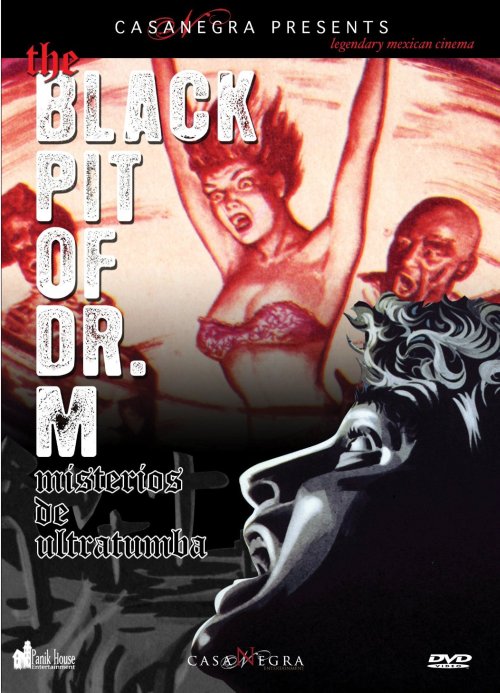
Misterios de Ultratumba aka Black Pit of Dr. M [Fernando Mendez]

If Book of Stone was MR James material then 1959's Black Pit... (the original title is literally translated as Mysteries of The Grave) surely owes some of its flavor to that master of the sepulchral, Edgar Allan Poe. Like a classic Poe protagonist, Dr. Masali is eager to know what lies in the after-life, and to this end he compels his dying friend Dr. Aldama to “arrange” for him to transcend the boundary between life and death, and then return to the flesh. A seance conducted after Aldama's death reveals to Masali that at a specified time, a series of events will precipitate that will grant him his wish. As any fan of the horror genre will know, such wish fulfilment does not occur without its heavy price, and the realization by Dr. Masali of the price he must pay for forbidden knowledge forms the rest of the film's arc.


Black Pit carries all the features of the gothic horror tale – it fuses its macabre element with romance and melodrama, and its striking use of shadow-play (Victor Herrera) creates an undeniable atmosphere for the viewer. Even the low-budget production values and sometimes overwrought plot elements create a theatrical ambience that adds to the film's appeal, like with some of the classic Mario Bava gothic horrors. Rafel Bertrand's portrayal of the obsessed Dr. Masali is in perfect sync with the Poe-inspiations of the screenplay and the film should definitely be checked out by enthusiasts as a worthy experiment in horror from Mexico.