Some way into Aadujeevitham / The Goat Life (TGL), I started to wonder if the hall was playing it without the mandatory intermission. Normally, outside of festival screenings, cinemas in India have to have this mid-break for people to buy snacks or empty their bladders, even with sub-100 min films. It was then I realized with a sinking feeling that this tedious survival saga of a Gulf-bound Malayalee in the 90's shanghaied as slave labor for an isolated goat farm in the searing desert was going to run for around 3 hours. My feelings then mirrored those of the harrowed protagonist.
I realize that sounds rather insensitive. I'm not against downbeat survival dramas, no. Some amazing books and films have come from this genre. But throughout the running time, I was never once able to sufficiently empathize with the character to feel his plight. It's a real pity, since it is based on an affecting true story, and there is certainly a lot of effort taken in the making, not least by lead star Prithviraj Sukumaran. As the protagonist Najeeb Mohammed he dons a rigorously de-glammed unkempt avatar for most of the film, and even undergoes a body transformation to represent what Najeeb had become after two years of slavery. I also appreciate that the film remains faithful to the idea of Najeeb barely surviving his ordeal, not becoming some kind of hero that fights back and defeats his oppressors.
The film offsets the scenes of Najeeb's grim fate in the desert with memories of his life in Kerala where he has left a loving wife (Amala Paul) pregnant with their first child. Water and greenery feature heavily in these memories (and fantasies), contrasting with his arid, sandy present (DoP Sunil KS). It reminded me of Shaji Karun's 1994 film Swaham, which contrasted the grim present of the widow protagonist with her happy past by depicting the former in black and white and the latter in color.
Sadly, those are the only good things I can say. A great survival film is made by its little gestures and micro-moments. I can empathize with the character's plight only if I find the character interesting to begin with. In TGL, writer-director Blessy's script is cringingly broad-strokes and pedestrian. At one point, Najeeb and a fellow Malayalee team up to escape with a North African slave (Haitian actor Jimmy Jean-Louis, who looks like he was participating in an Idris Elba lookalike contest). I get that the African guy is better used to surviving the desert environment than these Keralites, but they behave like such headless chickens, you want him to throw up his hands and abandon these idiots to their fate, instead of being the noble Samaritan who repeatedly pulls their asses out of danger. A little later he literally disappears from the film, suggesting that he preferred to commit suicide than bear any more idiocies.
But the worst part of TGL was AR Rahman's score. It's so bad in its choppiness and overbearing sentiment it made me nauseous and feeling like my ears were being bored by a power drill. I was undecided whether I wanted to repeatedly stab at his jugular, wrench his balls off with rusty pliers or ram a barbwire wrapped club up his butt.
I understand the hype this movie has got, and the trailer did a great job of selling it as an edgy saga, but after surviving through the ordeal I felt like an utter goat for having signed up.
Two years back, there was a Malayalam survival adventure called Malayan Kunju (MK). I had a very divided experience with that film: while the survival aspect - a guy buried under a landslide must claw back to the surface - was well executed, the preceding drama that shows him to be a self-centered casteist prig was a stodgy affair. Manjummel Boys (MB) is in some ways reminiscent of MK. Here too, a guy is deep under the surface, after falling through a pit that seems to go all the way to a netherworld (this hellhole is even called the Devil's Kitchen). But unlike MK's tale of redemption, this is a tale of brotherhood, the enduring bond between friends that will go to any length to look out for each other.
Of course, this also implies that the chaps have a tendency to invite trouble. In the extended introduction, we see these 'boys' (played by actors in their mid-to-late thirties) trade juvenile barbs with a rival tug-of-war club, and even an impromptu dare match which they lose. Later, when out on a guys-only trip to hilly Kodaikanal (Tamil Nadu), they get up to the tomfoolery of boisterous hooligans, sneaking drinks and ignoring the trespass notices. A major element in MB is its tribute to the 1991 Kamalahaasan movie Gunaa, incorporating dialog and song references and most importantly, returning to the striking cave locale used here:
As a setting, the 'Gunaa Cave' is cinematic gold. It exudes an aura of mystery, a primitive stony terrain with high ceilings and precipitous edges that dwarf the human characters tramping through. There's perhaps even an element of nature's revenge - it is after the boys mark their presence with graffiti on the rock surface that one of them (Srinath Bhasi) falls through the aforementioned pit. Following a series of sickening thuds, he appears to have been wiped entirely out of existence. The abruptness of the moment sends a shock, both to the other characters, and to the audience.
After several moments of disbelief - they keep insisting that Subhash must be pranking them, because the alternative is unthinkable - harum-scarum rescue efforts are set into motion. Some of them zoom off to the local police station to get help. There they get beaten and locked up for breaking the rules, possibly even murdering their friend. Those that remain in the cave do futile things like using their bodies to block water from a thunderstorm flowing into the pit. Even the authorities arriving at the site seem reluctant to rise to the call of duty - the firemen are scared of roping down into the depths of Devil's Kitchen and the police seem only too eager to file a fatality report and call it a day. Finally the group leader Siju David aka 'Kuttan' (Soubin Shahir) has to beg for the chance of going down to find and rescue their friend. Balding pot-bellied Kuttan has no experience with spelunking, nor is he some daredevil. But he cannot consider forsaking his fallen companion. What follows is a tense rescue drama - Lowered into impenetrable darkness and aided only by shouted instructions from the people above, Kuttan must tackle the tortuous descent and his own rising panic.
As critic Baradwaj Rangan points out in his excellent review, a film based on true events must be an honest representation, but slavishly adhering to the facts of the case may not always be the best dramatic option. The ensemble of friends is a large one (11 members), and the script doesn't do enough to delineate the members - apart from Kuttan and Subhash, who fell into the pit, I don't recall the names or traits of the other friends. One of them seems to have been chosen for his passing resemblance to Kamalahaasan in Gunaa - he remains in a catatonic state for most of the picture. There is a reliance on cliche flashbacks to give a sense of the longstanding bond between them. But then, the numbers are required as a mechanical device: Remember the tug-of-war at the beginning of the film? You get the pay-off for it later. The flashbacks are a reinforcement of why the friends stick together despite all odds.
MB's extended epilogue hints at Subhash's PTSD after his experience in the caves - he is unable to close his eyes to sleep, to face darkness again, and needs his mother beside him. There could be an interesting short film sequel that deals with this specific aspect. But time is also wasted on a tedious subplot of how Subhash's mother blames Kuttan for his accident and only later comes to know of his brave rescue of her son, leading to an obligatory "tears of gratitude" moment.
Visually, there are some marvelous moments. While not quite Descent level, MB delivers on the claustrophobic near-hallucinatory experience the characters go through. There is a seamless combination of real locations and sets, an intimate communion between the production design (Ajayan Chalissery) and the cinematography (Shyju Khalid - Maheshinthe Prathikaram, Nayattu). If ever my favorite Indian disaster film Kaala Patthar (1979) went in for a remake, I would want the guys who made this to get a crack at it.
Despite the glowing review from my go-to movie critic Baradwaj Rangan, I had reservations about 12th Fail. Based (at least loosely) on IPS officer Manoj Sharma's life, the film details the story of how he went from being a 12th class fail to successfully clearing the hyper-competitive Public Service Commission entrance hurdles. From that outline, it threatened to be like the numerous cliched Indian sports movies of the last 10 years, only without the sportsing. And how does a film generate excitement about someone passing an examination - Ticking the right answer box hardly conveys the viscerality of scoring a goal or smashing a cricket ball into the stands, right? This worried me.
The other factor was Vidhu Vinod Chopra. Chopra made a name in the late 1980's with his crime thrillers Khamosh (1986) and Parinda (1989). The low-budget Khamosh was a first-rate mystery that cleverly used its film-within-a-film conceit; Even in its limited release it garnered eyeballs, and the unveiling of its suspense was a tour de force discussed by fans years later. Parinda - a noir mixed with Bollywood sentiment - was script-wise shaky, but its technical chutzpah courtesy his frequent collaborators - art director Nitin Desai, DoP Binod Pradhan and editor Renu Saluja - impressed cinephiles.
Post-Parinda, Chopra became Bollywood's Golden Boy. Sought after by stars and handed massive budgets, his next project 1942: A Love Story - an escapist period drama almost 5 years in the making - reflected the bloat of his ambition. The technical wizardry was there, but the storytelling was a meandering mess. The man who at one point was poised to turn the course of Bollywood had succumbed to its excess. 2000's Mission Kashmir, which Kashmiri origin Chopra claimed to be a passion project, reduced complex terrorism issues to childish outbursts and cartoon villainy. This was enough to put me off his cinema, and it coincided with his own hiatus from direction. Chopra was now content to produce films, majorly those of protege Rajkumar Hirani (the Munnabhai franchise, 3 Idiots, PK, Sanju). The subsequent occasional forays he made into direction (Ekalavya, Shikara) did not interest me at all. Still, Rangan's review, coupled with the praise from my other trusted movie reviewer Deepa Gahlot, goaded me to take this one in at the cinema.
In 12th Fail, we first meet Manoj Sharma (Vikrant Massey) as a high school pupil in Chambal, a province of Madhya Pradesh in northern India historically (in)famous for its dacoit gangs. It is also notorious for rampant cheating in the board examinations, which is not only permitted but actively supported by the school authorities. After an honest police officer (Priyanshu Chatterjee) disrupts the operation, Manoj and his entire class end up failing their year. That same officer later comes to Manoj's aid when he and his brother are hassled by the constabulary for crossing a local politico's goons. Manoj is inspired by the upright cop to become one himself, a dream that eventually leads him to the challenge of clearing the public service exams.
The story could have been one of Rajkumar Hirani's projects (I would not be surprised if it had started out that way). But I suspect Hirani would have loaded it with cute catchphrases and artificial sweetness. While 12th Fail has its own catchphrase in its repeated refrain of "Restart" it's used more sparingly. Also, Chopra at the helm brings in a lot more believable texture. It's not just in the production design, it's in the writing of the characters and the casting of actors suitable for the parts, instead of marquee names. The scale is deliberately kept small, detail substituting for scope. Manoj's dusty ill-lit village where he and his brother are suddenly burdened with maintaining the family, after their father (Harish Khanna) takes a suspension order for disobeying his corrupt superior's instructions, feels authentic. When he comes to Delhi, we are not given the scenic tour of the capital. Manoj's world is one of narrow crowded alleys, makeshift classrooms and dusty bookshelves. En route he has already lost the money his grandmother (Sarita Joshi) gifted him from her precious pension savings; he must clean toilets, mill flour and work other odd jobs to earn a living (the flour milling is also an analogy to the daily grind of his existence). These misfortunes are depicted with matter-of-fact restraint, focusing less on the tragedy and more on his resilience.
Vikrant Massey (Death in the Gunj) gets the lion's share of the applause for his committed performance in the lead part. But unlike other mainstream movies where the remaining cast is solely defined by their equation with the "hero", every character is etched and performed in a manner that transcends caricature. In a late scene, the aforementioned father meets with Manoj and tearfully breaks down over how his proud honesty has destroyed his family and that the poor can never hope to win. "But we can't admit defeat either," Manoj responds. Geeta Agarwal Sharma as Manoj's mother gets some memorable moments - check out the finely modulated scene of their encounter when Manoj returns home dejected after initial setbacks. Even the actor doing a one-scene part of a valet Manoj encounters when paying a surprise visit to his girlfriend in Mussouri comes off as a rounded individual instead of a stereotype.
As regards the girlfriend (Medha Shankar), this is in the end a movie meant for mainstream consumption; a romance angle is deemed mandatory. There are some gauche stumbles here, like when the girl Shraddha mistakes Manoj to be an aerospace engineer just because he is holding a book on that subject, which leads to a misunderstanding later. But Chopra and his co-writers keep it mostly integrated in the main narrative. Shraddha has her own little arc - she is an idealist that has quit medicine to join the IAS because she wants to ensure adequate treatment for the poor. While advancing on her path, she remains supportive of Manoj; without tomtomming feminist credentials, the film shows that the woman can be an equal, even superior partner in a relationship. The normally played-for-laughs 'hero ka dost' role is also depicted with greater nuance and substance: The easy-going Pritam Pandey (Anant Joshi) generously accommodates the struggling Manoj and backs him when he is down, but when Pritam's own fortunes turn, it affects his outlook and their bond of friendship. Again, this is handled in a credible and sympathetic manner.
Right from his early films, Vinod Chopra was regarded as an Indian Brian De Palma, a brilliant visual director. In 12th Fail his command over the form continues: DoP Rangarajan Ramabadran employs handheld tracking, overhead shots, complex pans, the works. And Chopra, who at one point created some of the most gorgeous images in Hindi cinema, is not afraid to use unflattering source lighting or grimy textures. It is an uncharacteristic yet welcome shift that feels more like the effort of a fresh and hungry filmmaker. More importantly, it is all in the service of the storytelling.
In a time when mainstream Indian cinema is regressing with its extended celebration of machismo jackasserie, it is wonderful to see films not about gym-bred jocks tossing off hordes of minions in slow motion with barely a scratch on their well-oiled pecs. Armed with only the grit to withstand life's trials, Manoj Sharma held steadfast and finally reached his goal. A similar determination to telling an honest story allows 12th Fail to make its place in our hearts. I award it a First Class.
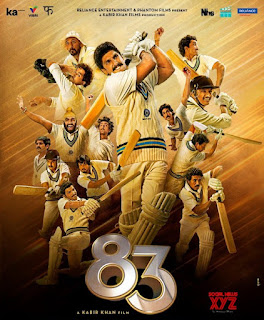
If despite all of Kabir Khan and his team’s missteps, ’83 - the story of how the Indian cricket team under Kapil Dev's captaincy went from being complete underdogs to reaching the finals and defeating champions West Indies (WI) to pick up the trophy and forever change the future of the sport in India - works as a sports drama, it is because of the incredible true story behind it.
The screenplay (Kabir Khan, Sanjay Puran Singh Chauhan and Vasan Bala) defines lack of focus. If they were trying to tell the story of India’s entire journey through the World Cup, it should have been an ambitiously mounted miniseries, India's answer to the Bodyline series, which we adored as kids. Or if they had decided to make a feature film, they should have done better than a collage of mostly rushed moments that do not give the epic build-up the narrative deserves.
For instance, they could have begun with the knockout match against Zimbabwe when India was at its ebb, and the manner in which Kapil almost single-handedly brought back the team from the brink of ignominious defeat, inspiring them to become the world-beaters they did. A gutsy film-maker would even have considered capturing the Zimbabwe game alone since it was also the sole unrecorded match in the '83 World Cup (due to the BBC being on strike that day, and most of the press being at the WI-Australia game). In the bid to cram in every match India played in that series, the games are reduced to highlights on steroids; there is no build-up or flow in their depiction.
Star Ranveer Singh makes an impact with his uncanny ability to absorb and emulate Kapil Dev’s persona. I must admit here that I am not per se a cricket fan, but as a kid the handsome toothy open-faced persona and flashy playing style of Kapil Dev would attract me enough to sit down to watch a cricket match. The two dialog scenes that really stood out for me are a) where Kapil vents about how the one thing that makes him angry is people’s lack of expectations from India, and b) when Krishnamachari Srikanth (Jeeva) gives a speech about the ‘mad’ captain who actually thought they had a chance to win this series when no one else did.
There are the occasional field action segments when the film takes a moment to focus, and provides some delights. The depiction of the Zimbabwe game, while still too truncated, gives a taste of what could have been. When Ranveer's Kapil gives us his iconic Nataraja pose while slamming the ball all across the ground (and smashing several window-panes and even windscreens of cars parked outside the stadium), it is hard not to feel goosebumps and lumps in the throat.
While it would be foolish not to expect a grand show of patriotic fervor in one of the country’s most significant sporting moments, there are scenes where this goes into puerile jingo: For example, the Indian team sitting in their bus after being thrashed by the Windies in their second encounter burst into happy tears seeing a lone Indian flag waved by a kid, and I am not sure the armed forces appreciate being represented as people who are caught unawares by shelling while glued to the radio for cricket updates. Even considering 80's hair, some of the wigs are awful, and there are some really cringy homages, like Mohinder Amarnath playing his own father Lala Amarnath, Kapil Dev playing a spectator cheering himself (what was that about?!), and a cloying reference to a child Sachin Tendulkar.
Thankfully the real life legend manages to overcome these glaring potholes and one is still glad that a new generation of Indians (and sports fans in general) can relive one of the great cricketing moments in Indian history, one that, beyond the sport itself, forged a nation more confident in its own worth.
Gold is the story of the the first post-independence Indian hockey team playing in and winning the gold medal at the 1948 Olympics conducted in Britain. It is one of those "loosely based on true events" stories, meaning just about everything other than the bare outline is made up. The fact that the real Indian team thrashed Britain 4-0, while here we are shown a cliffhanger climactic match in which they manage to, at the very end, snatch victory from an unfair opposition tells you what kind of biopic this is.
It would be okay if it was at least made up in an interesting way. Sadly, Reema 'Talaash' Kagti's film pays a lot more attention to detail and verisimilitude in the production design than in the writing. Even as a fictional character the story of Tapan Das, a man who surmounted all manner of obstacles, including his own demons of alcoholism, to put together and guide the team that won the medal, might have been worthwhile if it had been invested with more layered characterization and entrusted to a gifted performer (Manoj Bajpayee, Irrfan Khan, Nawzuddin Siddique - any of them could have owned the part). Here it is wasted on Akshay Kumar dropping yet another big smelly deshbhakti turd. He is supposed to portray a Bengali with a drinking problem; neither aspect carries the required conviction. Mouni Roy as the stereotype nagging-but-affectionate wife only draws attention for her lips, injected with so much silicone they resemble baggage handles.
The supporting cast is talented, but let down by flimsy development. The most notable are Amit Sadh as an affable but egoistic blueblood, Sunny Kaushal as the hothead working-class Sikh who resents him, and Vineet Kumar (Mukkabaaz, reviewed HERE) as a Muslim player who, shortly before the Olympics, opts to shift to Pakistan. Kunal Kapoor as a former captain turned coach is limited to looking noble throughout and his character is an all-too-obvious deus ex machina. Atul Kale plays the jealous sports official de rigueur in almost every Indian sports drama. The bickering between the players, the lessons they learn, the quick-fix remedies for serious issues, the speechifying about setting aside individual egos for national pride...everything is so rote, there's little joy in watching the drama unfold. Lagaan and Dangal were also stories that followed a predictable path, but in building up of little incidents and the peculiarities of their characters, they made us care for what happened. Here, the story of a team that came together for a common (ha!) goal is subverted into a self-serving glory piece for a fictional character purely because he is played by a box-office draw. The makers of Gold would have done better to paraphrase JFK's famous line, "Ask not what your film can do for your star, but what your star can do for your film".
2019's Virus is a movie about the epidemic outbreak of Nipah virus in 2018 that was successfully tackled by the health and administration authorities in Kerala. While it is not identical to the Covid-19 we are facing now, it shares some notable characteristics and is important from the POV of depicting what an administration is made to do in such a crisis situation.
The ominous electronic music at the start of the film signals an impending disaster, which is not long in coming. The Kozhikode Govt Medical College Hospital sees a couple of patients who are suffering from fever and vomiting, and within a short period have massive blood pressure spikes and convulsions, and die. When the possibility of a contagious disease is hinted, the patient samples are sent to the Manipal Institute of Virology where the infection is confirmed to be of Nipah virus, a deadly pathogen with a high mortality (~90% of all infected), previously known to have created havoc in countries like Malaysia and Bangladesh.
The administration meets with health authorities and acts quickly, ordering a wide quarantine. But as more cases come in from different places, it becomes crucial to track the source of the virus and its mode of transmission between these seemingly unrelated people - unless a natural mode of transmission to each of the patients is conclusively established, they will also have to consider the possibility of a biological warfare plot. Thus along with the medical angle, Virus is also a serial killer mystery, only the killer is a germ.
To tackle this tangle of threads, Virus adopts a back-and-forth narrative. Many a time during the course of the emergency, the story winds back to the circumstances under which each of the infected (or the people around them) could have been exposed to the pathogen, thus revealing the links of the chain that connects them. This makes following the story occasionally tricky (if you can't recall all the faces you've seen), but it is essential to encompass the sprawling multi-directional cascade of events.
The cast is a Who's Who of modern sensible Malayalam cinema - Revathi, Tovino Thomas, Parvathy Thiruvothu, Kunchako Boban, Srinath Bhasi, Indrajith Sukumaran, Reema Kallingal, Shoubin Shahir, Dileesh Pothan and many others - some of them have big roles while others are in only a few scenes, but each commits to their part. Of course in a non-melodramatic thriller like this, it can mainly be a matter of looking grim and speaking in undertones, but they do what is required without drawing attention to their individual selves, which is laudatory for an ensemble production.
While the editing is in itself tight, some monotony is generated in all the back-and-forth. But this is reflective of the actual situation of the management of an epidemic outbreak; as someone rightly said, it is how well we can manage the gap between "being afraid and "growing tired of being afraid". As an engaging film in itself and as a reminder to all of us, the enormity of the challenge faced daily by the people forming our first line of defense against an insidious, tenacious enemy, Virus is a must-watch.
What is it with the French and crime procedurals? They seem to have an
almost innate talent at turning out kickass movies centering around
criminals either carrying out a caper or escaping from custody. Jules
Dassin's Rififi, Jean-Pierre Melville's Le Cercle Rouge (and any others I've missed), Claude Sautet's Classe Tous Risques.
These often feature a set-piece where a delicate and risky maneuver is
depicted in exquisitely excruciating detail, making the audience feel
one with the participants and feel their tension. I am happy to have
found Jacques Becker's Le Trou (aka The Hole) to be another proud member of this clique.
Becker's film was adapted from a book (written by José Giovanni) based on a true-life prison escape
attempt. A group of men sharing a cell make an audacious plan to escape
from their confines by digging their way into the underground sewer
system from where they can tunnel out of the prison. Jacques Becker's
commitment to capturing the realism of the event was so great he not
only had sets built to closely correspond with the original locations
and shot the prison cell scenes in an equally cramped and claustrophobic
space, one of the major actors in the film (Jean Keraudy, he called
himself) was a real-life participant in the original escape. Becker
decided to use Keraudy after speaking with him and becoming extremely
interested in the colorful inventive man, and decided to populate his
film with non-professional actors.
Le Trou is almost entirely set in the confines of the prison. It begins
with one of the characters entering as a new occupant in the cell
already occupied by four men. After chatting with the new man, they
decide to accept him as one of their own group and include him in their
escape plan. The film covers each aspect of the escape with loving
detail and an eye for realism. When floors and walls are dug through,
they don't just break apart in a couple of blows, but take about as much
effort as you would expect concrete structures to. Iron bars take a lot
to be sawed across. Between each set of operations the gang has to be
careful to wipe off or put away all traces of their covert activities.
The film establishes a routine and constantly reminds us of it. In the
wrong hands this could have ended up as a rote and boring exercise, but
between the screenplay, the actors, the superb production design and
strikingly austere B&W photography, we become one with the rhythm
and are constantly riveted. When they break through into the sewer
labyrinth and open a manhole to see the road outside the prison, there
is a palpable sense of fresh air and freedom.
Do they actually
manage to escape? I recommend you watch Le Trou to find out. But Becker's film is not just about the suspense. The prisoners are not action figures carrying out the motions. They have personalities and the relationship between them - trust, friendship, brotherhood - is equally important, in fact the lynchpin of the film's lasting impact.
Indian cinema's history of military films has been spotty. Unlike Hollywood's close ties with the US armed forces allowing the studios access to military equipment and manpower, relevant technical information and other resources, in return for a positive heroic showcase to the public of the actions of these forces (and cushy consultant positions with showbiz exposure for current and former military personnel), there are at most a handful of such collaborations out here. Then there is the matter of wedding a battlefield story to the stereotype ingredient-based melodrama structure of mainstream Indian films down the ages. Pushing aside the ones where the protagonist being a soldier is just a throwaway backdrop detail for a standard Bollywood product, it is hardly a surprise that we have very few military action focused movies (and only a subset of those have reflected contemporary / near contemporary events). Chetan Anand's Haqeeqat (1964) inspired by the Sino-Indian war of 1962, would appear to have established the paradigm subsequent desi battlefield narratives styled themselves upon. In the more recent past JP Dutta contributed to the Indian war movie genre with Border (1997), LoC Kargil (2003) and Paltan (2018). But these films in order offered steeply diminishing returns, on account of shamelessly rehashed story and character beats, and reduced quality of execution. Almost the only Indian film that seriously explores the soldier's psyche and his place in society is actor-director Nana Patekar's 1991 film Prahaar (and even that eschews the military backdrop in its second half).
Which is not to say that Aditya Dhar's ambitious debut film, based on the covert military ops carried out by Indian armed forces in enemy territory defies convention. Here again you have the heroic Indian soldier, who having faced tragedy from terrorism / foreign aggression, goes on a mission of national (and to some extent personal) vendetta to tell the enemy that their actions will, following Newton's Third Law, cause equal and opposite reactions. Critic Baradwaj Rangan's review has even likened it in outline to 80's Bollywood gratuitous revenge dramas like Hukumat (1987). But there is a focus and visceral propulsion in Uri's execution that invigorates the genre for Indian cinema. In few and bold strokes the film introduces its small cast of main characters and sets up the central conflict, the attack on the army camp at Uri in Kashmir by four insurgents who ended up murdering 21 soldiers before they were felled. The tragic blow to the armed forces and the nation at large is supplemented by a sense of personal loss when our protagonist covert ops specialist Major Vihaan (Vicky Kaushal) loses his brother-in-law to that massacre. Vihaan, who had by then shifted to a desk job to care for his ailing mother (a dignified if prop-like Swaroop Sampat), asks to be reinstated to field operations in the retaliation planned by the Indian army.
The entire second half of the film is devoted to the mechanics of planning and execution of the retaliation through "surgical strikes" hitting terrorist training camps in enemy territory - reconnaissance of enemy locations, gathering information through spies and from captured hostiles, detailing of operation parameters and preparation of the people involved in the actual op. Unlike an all-out war with rank-and-file soldiers, the surgical strikes employed a select band of elite warriors armed with rigorous training and technological aid. Modern combat rifles, night-vision goggles, binoculars with face recognition tech, body-mounted cameras, surveillance drones - as much as anything else, the film serves as a showcase for the sophistication and technical competence of the Indian armed forces as a world-class fighting force. The visual slickness is complimented by the laser-sighted focus of the script - there's no time wasted on throwaway romances (none of the women in the film are love interests), cloying religious integration (Vihaan passes by a group of his team members offering namaz but no big deal is made of it), no one makes big speeches and the patriotism is not expressed through bovine-tempered never-ending ballads. The film revels in a spirit of (positive-minded) aggressive nationalism. At the same time, it is careful not to espouse a tasteless political bias. The characters standing in for real-life politicians are shown to be supportive of military decisions, but not directing them; Rajit Kapur may be made up like Narendra Modi but he behaves with a restraint lacking in the real McCoy.
There are of course the usual exaggerations and fabrications of any mainstream film. A bird-shaped drone used for overhead spying is shown to be the brainchild of a college intern at the DRDO (even if it was, wouldn't the army just ask the kid to write down the instructions instead of depending on him to take part in actual espionage ops?). The enemy is depicted as an indolent moron - Pak military council members shown to be more interested in golf and yakhni pulao than studying India's response to their activities, none of the militant camps have watch towers or night sentries - and the Indian soldiers have almost no worthwhile challenge in carrying out the mission (you're making stuff up anyway, why not invent things that add more tension in the narrative?). But as part of the new breed of Bollywood cinema, Uri-TSS is commendable. Some years ago, such a vehicle would have been unthinkable without a big star name attached and all the baggage that comes with that. Vicky Kaushal is not the first name that comes up when you think action hero, but he turned out to be the perfect choice. He invests himself physically and mentally into the character of Major Vihaan, and infuses him with a controlled exterior and an inner fire (how you wish some of this attitude had shown in his Raazi character). When he gets his slow-motion walk towards the end of the film, you feel he has earned it. The supporting actors (Paresh Rawal, Mohit Raina, Kirti Kulhari, Yami Gautam) may not sport well-rounded characterizations but they have defined roles and are not just props to accentuate the protagonist. Unlike other Indian military and patriotic films, Uri refrains from endless brandishing of the national flag / anthem, seeking instead to interest Generation Now in how cool and exciting an armed forces life can be for those that can handle the pressure...and yes, being terrific popcorn entertainment for the rest of us.
Last night I re-watched David Fincher's 2007 movie Zodiac and the film still manages to grip. Zodiac looks at the investigation of a series of unsolved murders during the late 60's and perhaps early 70's in the San Francisco Bay Area, committed by an intelligent but crazy killer who called himself the Zodiac, and after the acts sent taunting messages to the police and the press. This led to significant panic in the region, especially when the Zodiac in a published letter speculated about attacking school-buses and killing children, a plot point used in the first Dirty Harry (1971), which based its cold-blooded villain on the Zodiac.
In Fincher's film we see the investigation from the point of view of SFPD investigators David Toschi (Mark Ruffalo) and Bill Armstrong (Anthony Edwards). The Zodiac's letters and cryptograms sent to the SF Chronicle newspaper also attract the attention of its crime journalist Paul Avery (Robert Downey Jr) and cartoonist Robert Graysmith (Jake Gyllenhaal). While Avery's speculation on the Zodiac being a latent homosexual earned him a death threat (which the film suggests led to Avery's deterioration along with his alcoholism), Graysmith became obsessed with identifying the killer, unofficially interacting with the police and compiling information over several years, even to the detriment of his family life.
Zodiac is mainly a procedural, interested in the details of the investigation, the politics of cooperation between different jurisdictions, the landslide of drudge-work and official pressure once the killings become public knowledge. Unlike Fincher's previous serial killer feature Se7en, this film is not particularly interested in the killer's motivation or in exploring his psyche. And despite its lack of a conclusive denouement (although there were some strong suspects the killer was never identified) Zodiac also does not have the nihilistic aftertaste which defined its predecessor. The case dies down, Toschi and Graysmith carry on with their lives.
Under Fincher's measured vision, Zodiac for all its sprawl is an unrelentingly focused film, eschewing high style but still keeping us engaged all through its nearly 160min running time. Especially in Ruffalo's Toschi, we see an investigator doggedly pursue his quest, growing older and more frustrated as time wears on with no clear answers forthcoming. Gyllenaal's Graysmith goes from cheerfully curious to disturbingly obsessed. He is so convinced of a suspect's guilt he says, "Just because you can't prove it doesn't mean it's not true" only for Toschi to respond ironically with "Easy, Dirty Harry".
A few notes on the blu-ray release for those interested:
I got Paramount's 2-BD set in 2011 for nearly 30$ when it reported to be going OOP. The only other option that time was the UK release in which film and HD extras were all stuffed onto a single disc (and lossy Dolby instead of the US release's TrueHD track). unfortunately for me, in this case, what going OOP meant was that Paramount's film library was going to be distributed by Warner Bros in the US, and so that same package came to be re-released by Warner (and later by Paramount again), frequently hitting the sub-10$ bargain bins. Gnaar! Oh well, so long as one doesn't compare it's still a strong offering for the price.
Zodiac was shot digitally, and although I think 35mm would have been stunning, it looks quite good (Fincher's penchant for yellow filters aside). It is the first time since getting a surround setup that I am watching the film and I'm shocked at how front-loaded the track is. Most of the time I can't hear anything significant from the rear speakers. Dialog occasionally struggles for clarity above the music and ambient effects.
I have seen most of the extras on previous viewings but outlining them for completion's sake: On the feature disc there are 2 commentary tracks, one with Fincher and one with the actors, writers and whoa, James Ellroy. Disc 2 contains a multi-part making of the film, showcasing Fincher's obsessive penchant for authenticity of props and huge number of retakes. Of course everyone is in awe of the director and gushes over the opportunity to work with him. There is also a feature-length documentary covering the confirmed Zodiac murders, talking with investigating police personnel and survivors of those incidents.
In an interesting coincidence the last film I saw also dealt with historic events during WW2. This time I'm talking about the 1955 war movie The Dam Busters. Quite a good one, it reminded me of David Lean's In Which We Serve
(and I learned from the retrospective making of that the director
Michael Anderson had assisted Lean on that film). It's a story of quintessential
British valor and scientific thinking used to score a tactical victory
in 1942 on the Germans by destroying some major dams adjoining their
factories and thereby crippling their armament manufacturing capacity.
Of course, from the other side, one might think a lot of German
factory workers probably died or were rendered homeless in the deluge,
but then war as a wholly ethical "soldiers only" enterprise probably
never existed.
Based on the actual events of Operation Chastise, the film begins with
scientist / engineer Barnes Wallis (Michael Redgrave) coming up with the concept of
a "bouncing bomb" when dropped from an aircraft in a precise manner
would skim over the water (like pitching stones across a pond) and
finally slide down next to the dam wall, the consequent explosion
causing greater damage than an attempt to directly hit the wall from
above. Wallis stakes his reputation on the plan, even resigning from his
position before the war administration allots him the necessary
facility to scale up and test his idea. The plan involves using a series
of air sorties that will repeatedly bounce bombs till the structure
breaks, so you have a special squadron of experienced pilots assembled
under Guy Gibson (Richard Todd, who was himself a decorated serviceman in the war), who run a series of test missions. There are failures and setbacks
till the idea is perfected, barely before it is time for the actual
execution (in mid-May, when the tide was highest and the damage from
the dam bust expected to be the most).
The film had the support of the British armed forces and Anderson paid a
lot of attention to technical detail and authenticity, and thus the
scenes of preparation and aerial attack are both credible and thrilling. It also helps that the
British war film shows the operation as disciplined team-work and stiff
upper lip, and less of swaggering war heroics (apparently Howard Hawks
had proposed a script which he sent across to Barnes and others for
inputs but they were offended by its tone and did not revert to him).
The only niggle is the weak optical effects used to show flak and
gunfire in the scenes where the sorties battle German defenses to reach
their targets. Against the other elements they look very out of place,
although I don't know what they could have done to alleviate it given
the budget and technology at their disposal.
OK, just
a heads-up in case anyone else goes in to this one blind. There was a language warning before the film opened and disclaimers
about prevailing culture, and I didn't realize what it was about till
the character of Guy Gibson called out for his dog with the N-word. It is
a bit of a shock and one wonders how the Peter Jackson remake that was
floated at one point would have addressed it (oh wait, here) but it's historical fact
and no way to retrospectively take it out without seriously mutilating the picture.
Over the weekend I watched in its extended Japanese cut the 1970 war movie Tora! Tora! Tora!
(TTT), which covers the 1941 bombing of Pearl Harbor by the Japanese
military and documents the events leading up to this audacious attack
which roused the US into becoming a major participant in the Second
World War.
The key element powering all the decisions about the making of TTT
was its meticulous attention to historical detail and authenticity. Thus
we are privy to the backroom discussions among the military and the
politicians, the cat and mouse game played between the US and Japan.
While the US (or at least Congress) was still undecided about taking an active role in WW2, the
major bone of contention for Japan was the US opposition to its
invasion of China, which led to trade sanctions blocking their access to
war resources. While ostensibly continuing negotiations Japan
surreptitiously organized a full scale guerilla air attack (planned by Commander-in-Chief Isoroku Yamamoto) on the US
military base at Pearl Harbor in Hawaii. Although American military
had vague rumblings about Japan's plans, a combination of indefinite
knowledge and their own complacency led to their being wholly unprepared
on that fateful Sunday of December 7, 1941, when Japanese fighters
launched off carrier ships positioned nearby, and in two waves managed
to damage several US carrier ships and destroy a large portion of parked
military planes. More than 2000 men were killed and a thousand more
seriously injured in the attack which was made before Japan had formally declared war with the US.
The film was a prestige project for 20th Century Fox, who were looking
to replicate the enormous success of their Normandy invasion film The Longest Day.
It was planned as a US-Japanese collaboration with film-makers from
each nation telling the story from their viewpoint. Versatile journeyman
Richard Fleischer directed the American portion of the story making use of a respected American ensemble cast including Martin Balsam, EG Marshall, and Joseph Cotten. Akira
Kurosawa's name was attached to the Japanese side of the project and he
worked the script with his regular screenwriter team, but a couple of weeks into
filming he either quit or was let off because of his disinclination to work
in tandem with the American studio. Then Toshio Masuda and Kinji
Fukasaku were brought in to complete the work. The Japanese cast included Kurosawa regulars Eijiro Tono and Susumu Fujita.
The film is excellent as a visual classroom lesson telling us about the
event and what led up to it, but it is dramatically quite flat, mainly
because the people we see till the events of the actual attack are not
caught up in it, and so there is no dramatic tension. There are lots of
facts here but very little feeling. The film seems overly cautious not to make any individual appear as a villain or a blunderer (most notably its sympathetic treatment of US Commander-in-Chief Husband Kimmel, who was demoted after the debacle). Also it is quite obvious that the
characters are more puppets to dole out information than 3-dimensional
people (Within this limitation, the Japanese segments are
better directed and carry more emotional impact, possibly because the Japanese side has a more defined purpose). The last 20 odd min are
devoted to showing the actual assault, which is fairly thrilling, with
some very dangerous moments captured on film. On the whole, while not as emotionally gripping as some of the classic British war films which follow a similar
template, this is much preferable to the 2001 Michael Bay directed Pearl Harbor,
which made a trite romance the center-piece of a deafeningly loud and
pedestrian film. Probably as a function of which country regarded the attack as memorable, TTT was not well-received in America but a major success in
Japan.
From the director of the political thriller Z (which was also adapted in 2012 by Indian film-maker Dibakar Banerjee as Shanghai), The Confession is another film which looks at corruption endemic to power. It is based on the book written by Czech communist politician Arthur London. Played by French movie star Yves Montand, the film looks at how London, appointed as a deputy minister of foreign affairs just 2 years prior, is suddenly brought in for questioning about his past dealings and accused of being a traitor to the ideals of the ruling communist party. The interrogation, dealt with in great detail, is really more a process of extended torture. Made to keep walking inside his cell, barely allowed to sleep or eat, an increasingly disoriented London is alternately yelled at or coaxed by his tormentors to confess to deliberate treason against the state. Initially London denies the charges vehemently, confident that his basic innocence and his political connections will soon lead to his release. But they are relentless, breaking down his emotional defences, chopping up his testimony to individual sentences and then rearranging them to suit their purposes. London and several of his colleagues are put up for what is called a show trial, one where the guilt of the accused has already been decided and the court proceedings are merely to make a strong example of them. As part of the notorious Stalinist purges, of the 14 people accused at this trial, 11 were executed and 3 - including London - sentenced for life. He was released 2 years after Stalin's demise.
Inherent to the nature of the film, there is a lot of repetition: we see day after day London undergoes repeated cycles of torture. He is held for months without official charges under emergency law where his persecutors have extraordinary powers. When London's wife (Simone Signoret) protests about her husband's abduction in the ministry, their house is seized and she has to take employment in a factory. By the time they have compelled him to sign on practically fabricated confession he has been reduced to a pale thin shadow of his former self (Montand lost 23 pounds over the course of shooting). Then in the period towards the trial they reverse the process, feeding and medically administering to him ("preparing the goose" London remarks), even using a lamp to give him an artificial tan, masking his continuous isolation. The film is powered by Montand's performance, but it's a performance wholly in service to the strong statement the director wants to make.
Gavras sometimes uses a non-linear style going back and forth in London's life. It is suggested that some of the trials he presided over may have obtained confessions of guilt using the same methods he is now subject to. Regardless of ideology, the people in power are invariably corrupt and hostile paranoia increases the more one climbs the ladder of political rule.
If such a thing were possible, I would like to place a bucket in front of every Indian director set to make a movie on sports / espionage / war and say, "Here, throw up every bit of patriotic fervor you have inside of you into this bucket and THEN go make your movie."
Meghna 'Talvar' Gulzar's film about a young girl from Kashmir (Alia Bhatt) arranged to be married into a Pakistani military family with the agenda of functioning as a spy for her home nation in the period leading up to the 1971 war is not as jingoistic as some of the worst offenders in the genre (there is no hyper-macho posturing and I don't recall any scene where either of the national flags are flying), but that's about the only good thing I can say about it. The idea had potential but it needed to be done well. Look at the level of tension a Quentin Tarantino can raise through simple dialog scenes in Inglourious Basterds purely by suggesting or implying possibilities. A wartime spy drama unable to generate any real sense of urgency is a tragedy.
In a time where all kinds of movies ill-advisedly attempt non-linear narratives with timeline jumps, Raazi is one film that could have actually benefited by such a treatment. They could have started the film with the marriage, and the girl going alone into foreign territory, vulnerable and beset by fears. Then as she gradually starts her mission they could have given brief glimpses of the training she received and is now putting into practice in the face of real danger. But no, after an eye-rolling "your daughter will do your patriotism proud, daddy" speech (to a Rajit Kapur bandying Rahim Chacha level stuffed shirt nobility, and that old Bollywood standby, CANCER) Alia gets an entire Rocky-style training montage with rah-rah song backdrop. At the end of the montage she asks her hardass trainer (Jaideep Ahlawat, an actor that deserves better) if he thinks she can do the mission, and he replies that he is confident in her. That moment pretty much deflates any possible tension for the massive chunk of movie-time that is yet to come.
The other aspect is the emotional conflict of the girl "betraying" her new relations. To the script's credit they are always shown as a progressive loving family, whose only difference of interest is in the nation they owe allegiance to. However, there is never a true sense of bond-building. These are the people Alia's character must come to rely on as emotional anchor in a strange place. It is the sense of familial belonging with these Pakistanis that must generate the turbulence in her mind about her actions. But almost always she seems to be playing the spy role, and her actions, even when she wins hearts by training schoolkids to perform a patriotic song, are viewed purely from that perspective. More disastrous is the casting of Vickey Kaushal as her Paki husband. The marital relationship between the nubile girl and a chivalrous military gentleman should have been a lynch-pin of romantic passion and emotional turbulence powering this whole enterprise. Alas Kaushal's military man is a modern day Bharat Bhushan, a pitiable wallflower. The chemistry between them is colder than an ice-lolly in an Antarctic winter. When the moment of open conflict comes, you feel little empathy for either one.
Alia Bhatt's performance falls victim to bad writing and direction, consisting in large measure of breathing heavily against latched doors. Nonetheless she gets a fine climactic outburst in which the young girl inside of her spy wants desperately to go home. Of course they have to spoil that moment too with a soggy epilogue no one asked for. Give this Raazi a Razzie.
1988's Jack the Ripper (JtR) made an impression on me when I saw
it as a kid on Indian TV where it was screened in its original 2 part
mini-series avatar, possibly in the same year or only slightly after its
UK premiere. It was possibly the first time I'd heard of the killer
although now I can't be sure (because around the time I also had a World's Greatest Serial Killers
book. Like the Sherlock Holmes series with Jeremy Brett, this was
another prestige production from British TV, shot on 35mm film with
handsome production design recreating Gaslight London, and thereby
rendered immediately attractive to me. Childhood favorites can often be
disappointing from a more mature POV, so how does this one hold up?
This telling of JtR purports to be a researched account of the original
killings and their investigation under Inspector Fredrick Abberline, with a
preamble stating, “Our story is based on extensive research, including a
review of the official files by special permission of the Home Office
and interviews with leading criminologists and Scotland Yard officials.”
As horror/fantasy specialist critic Richard Scheib points out in his
(ha!) surgical dissection of the film,
the claim is rather bogus. The writers are guilty of cherry-picking
some facts of the affair, while ignoring others and exaggerating or
outright inventing new elements for drama or sensation. While that is
certainly a failing, as is a certain half-bakedness that comes from
shoehorning characters simply to fit in US marquee friendly names (like
Jane Seymour as a former flame of Abberline), the film manages to keep
up pace and maintain interest. Without giving out spoilers, the solution
offered in this interpretation is even less convincing than the
Freemason conspiracy. But unlike the aggravating movie they made of From Hell,
JtR manages to be entertaining. Michael Caine is a sturdy Abberline
(even if they invent a drinking problem for the character and seem to
cram in unnecessary shouting scenes to make him earn his star-actor's
paycheck). The production design and Alan Hume's cinematography bring
the period to life and editor Keith Palmer does a good job of keeping
the momentum going.
Network's 2-blu-ray set contains the entire 2-episode airing on the first
disc in the original 4:3 aspect ratio with authentic lossless stereo.
The image (based off a fresh 2K scan of original materials) looks quite good, supportive of the textures of the production
and Hume's evocative visuals of night-time Victorian London. On rare
occasions the accents can slightly obscure a line but optional English
subtitles are present for any such difficulties. There are about 20 mins
of extras of a previous run for this project when it was going to be a
lower budget videotape production with another actor (Barry Foster)
playing Abberline - After American producers showed interest it was
remounted as a lavish 35mm production and Michael Caine was solicited as
a star name. The second disc (which I haven't yet seen contains a
re-edit of the series as a single film, framed for 16:9 widescreen with
specially commissioned 5.1 audio. I might give it a look on some future
occasion.
Normally, Second Run DVD is home to the less-known classics of European cinema (especially Czech and Polish), but they also sometimes do new releases like 2014's Spanish entry Stella Cadente, which was interesting but less satisfying than one hoped.
The falling star of the plot is Amadeo I, who came from Savoy to Spain in 1870 after being elected king by the Spanish legislature, only to find that the country as a whole did not want a king. Against advice, he refuses to abdicate, determined to be an ideal monarch. He bubbles with ideas of progress, freedom and prosperity, but is roundly ignored by the politicians he interacts with and even the palace staff, who tend to his needs but snigger at his back. His vegetarianism, compassion to animals and fidelity to his absent wife are seen as weaknesses in character. Till a time, his only companion is his Man Friday Alfredo (who masturbates into melons in open fields). The arrrival of his wife provides relief from the loneliness, but only temporarily. She makes him aware of the uselessness of his position, that of an abandoned captive in the palace (not unlike his bejeweled tortoise pet). Just 3 years after he arrived, Amadeo left Spain, which then declared itself a Republic.
Stella Cadente is a handsomely mounted vehicle that takes references from Lucino Visconti in its depiction of decadent nobility (albeit at a 106 min a lot less indulgent in running time), and Alex Brendemühl as Amadeo I gives a fine depiction of the ineffectual ruler. But the film is confined to too narrow a scope for us to experience Amadeo's frustration, and so much of the social backdrop is kept off screen, there is a paucity of context. Instead we get an anemic character study with some (bizarre or otherwise) sexual asides from the supporting cast (If you have a problem with male frontal nudity you have been warned). Also, I found the anachronistic song interludes off-putting.
While your mileage may vary with the film itself, Second Run's release looks great, although I was jarred by the idea of seeing a historical drama captured on digital video. This may be on DVD only, but they really push the limits of the format, offering lush colors and texture.
It is telling that 2014's Labyrinth of Lies was selected as Germany's entry for the Oscar for Best Foreign film. In a neatly laid-out manner it covers an "important" issue, of the 1963 German home-grown trial of former Nazis for their concentration camp atrocities, appeals to emotional heartstrings with writing and musical score cues that in no uncertain terms tell you what you must feel and also aims for mainstream appeal with its handsome Dicaprio-esque leading man Alexander Fehling. Fehling plays enthusiastic young lawyer Johann Radmann, a fictional composite of public prosecutors involved in the case, while making a pivotal but ultimately supporting character of Fritz Bauer, who conceived and spearheaded the legal onslaught to expose and lance the festering sore many Germans would prefer to have forgotten (Bauer is also supposed to have passed on crucial information to Israel that led to the capture of Holocaust architect Adolf Eichmann).
In the film Radmann is eager to prove himself with more worthy cases than the traffic violations assigned him. He picks up the trail of a school teacher identified by as an SS officer by a camp survivor, and is encouraged by Attorney General Bauer (Gert Voss). Radmann digs deeper to unearth a mass machinery of torture and murder that many ordinary Germans of the time were aware of, and complicit in deed. People exposed to Allied accounts of the Nazi evil will find nothing here that's new or shocking (the Nuremberg trials were held immediately after WW2 ended), but the German public remained for a long time in a state of shock and denial about the actions of their own government and people, of what crimes against humanity had been committed in the name of "following orders". Radmann carries out interviews with survivors and pores over several directories worth of documents to identify former Nazis associated with the camps. His investigation faces resentment and opposition, from his own colleagues and from forces in high circles. But with Bauer's support and encouragement he brings the case to trial, which is where the film ends.
LoL (an unfortunate abbreviation) is very clear-cut and sanitized, too much so to have much impact (at least for a non-German who doesn't have that kind of personal resonance with the issue itself). Compare this to David Fincher's Zodiac, which covered a far smaller scope (lone killer, half dozen victims) but with sufficient detail and layering for us to empathize with the emotional toll on the characters and see them as three-dimensional beings. Here, both victims and perpetrators are mostly cogs in the story machine for us to see the struggle and eventual victory against odds of the haloed hero (the latter are particularly flat, even the teacher is shown to harshly address a pupil just before he is arrested). There is also a romance with a pretty dress-maker, and a lover's tiff when he tells of her father's involvement in Poland. This is not exploration of a searing issue, this is HBO Movie of The Week.
Perhaps I'm being unkind. Perhaps this is the sort of film that needs to be made first, to allow people at large to accept this part of their history before they are ready for more studied works. LoL works well at that, but it is not by any means a great film in itself.
Budhia Singh - Born to Run is the biographical film of the wunderkid from Odisha who ran about 50 marathons before he was 5 years old. It's equally, and perhaps more so, a portrait of Biranchi Das, the coach who discovered young Budhia's ability and tried to hone it through punishing extremes.
Early on we see Budhia as an ordinary slum kid sold by his impoverished mother for 850 rupees as a domestic help. Biranchi, a Judo instructor, social worker nurturing a bus-load of kids and hired dogsbody for political parties, rescues Budhia from this situation and takes him under his wing. A chance discovery of the child's stamina (when Biranchi orders Budhia to run rounds without stopping unless told, and forgets about him for hours after) ignites the coach's desire to mould his protege into a marathoner. His formula is a mix of reward (Budhia gets new shoes and better food, compared to his foster home siblings, and more attention) and punishment (Biranchi puts him through a tortuous routine of long hours of running everyday, refusing even water during the endeavour).
While the use of a rah-rah "let's do it" soundtrack seems to put the film in the same bracket as other recent Bollywood sports films like those on Milkha Singh and Mary Kom, there is always an element of ambiguity in the depiction of Biranchi Das' attitude towards Budhia. While he may have rescued and nurtured Budhia (and the film makes a point of Biranchi's affection, even to the point of ignoring his own child), providing a more stable father figure than Budhia had previously known, he is also shown to be ruthless in his ambition to make the boy excel. Shots of Budhia running alone are intercut with scenes of his siblings and classmates enjoying a normal childhood while his teachers and principal gloat over the fame that his achievements will bring them. One of the most powerful scenes comes in the staging of Budhia's 65km run from Puri to Bhubaneshwar. Biranchi tagging alongside on a bicycle taunts Budhia with a water bottle but never gives it to him. The soundtrack dies down and we hear Budhia's faltering gasps, which are spliced with visions of cold drinks and ice lollies, the fantasies of a boy racked with unimaginable thirst. Towards the end of the race Budhia faints and is carried to an emergency station where he throws up the fluids he is made to drink. After this Biranchi takes him out to display to the crowd almost like a trophy, not exactly a hurrah moment.
The film also takes into account the allegations that Biranchi exploited the boy to fulfil his own desires for fame and fortune. Manoj Bajpai gives a trademark measured performance, fully embracing the character's ambiguity, making him alternately sympathetic and provocative. Young Mayur Patole who plays Budhia gives a non-cutesy blank-faced performance appropriate for a boy whose actions were entirely dictated by the people around him.
The Odisha Child Welfare Commission filed proceedings against Biranchi Das for exploitation, which led to Budhia's separation from his coach and a ban from long-distance running that only caused the wastage of a potential talent. In the film the committee is portrayed as a coterie of unimaginative babu-dom more interested in preening its feathers than any real concern for the boy. Shortly after, Biranchi Das was gunned down by unknown assailants, while Budhia languishes in the state sports hostel where since he has regressed to a life of mediocrity, resting only on the hope that we will once again meet a coach with the passion of his former mentor.
Aligarh is Hansal Mehta's attempt to depict the tragedy of an AMU
professor Shrinivas Ramachandra Siras (Manoj Bajpayee) who was illicitly filmed indulging in a
consensual sexual act with a rickshaw puller, hazed into admitting
guilt, and subsequently suspended by the authorities and pilloried by
shrill conservatives for immoral behaviour.
The script travels two
paths. The first is external, the struggle to restore Siras' position
and dignity through the press, in which he is supported by journalist Deepu Sebastian
(Rajkummar Rao), and through legal procedure (in the wake of the
landmark 2009 Delhi High Court judgement which amended section 377 of
the Indian Penal Code to decriminalize homosexuality, subsequently
reversed by the Supreme court in 2013, in who-knows-what wisdom). The
second path is internal, an exploration of the psyche of a lonely outcast.
Apart from his closet homosexuality, Siras was a divorcee single man,
who taught Marathi in an Urdu dominated institution. Despite this he was
appointed Head of the Modern Languages Dept (The film implies this was a
motive of jealousy for the sting operation, in which senior university
officials seem to have a strong hand).
Mehta displays a genuine sadness and anger towards the tragedy. The
collaboration between him and Bajpayee gives us a very
moving portrayal of a man who only wanted to be accepted for what he
was. Sexual orientation aside, the cruel bias faced by an ageing
bachelor in a society where marriage and family are the de facto
standard is something that anyone should be able to empathize with.
Every moment of his life, Siras feels the burden of being shunned and
judged by his peers. It is no wonder then, that even after the Allahabad High Court ruled in his favour, restoring his position and benefits, he committed suicide shortly after (There were some allegations of murder, but nothing was substantiated). While certain elements may seem overly composed and
deliberate, the film depicts this aspect with honesty and feeling.
Which is why the portrayal of the legal battle seems unnecessarily shrill. Of course, after Court,
typical courtroom dramas will always seem artificial, but Ashish
Vidyarthi's smug cockerel act as Siras' lawyer and the general theatrics
in this section are at odds with the subtlety depicted elsewhere in the
film. Still, Aligarh's core remains strong and the film is a
vital protest for acceptance and peaceful inclusion of differences
between human beings for us to retain the right to be called a
civilization.

 Posts
Posts