Showing posts with label French. Show all posts

Saturday, November 18, 2023

Falbalas [dir. Jacques Becker]

Prior to watching Falbalas, I'd only seen Jacques Becker's Le Trou aka The Hole, his jailbreak drama which engrossed me thoroughly (reviewed HERE). I have also heard a lot of good word about his crime drama Touchez pas au grisbi. What I liked about Becker was that his work seemed to cover a variety of genres.

Falbalas (translated as Paris Frills) is a drama set in the Parisian fashion world. Raymond Rouleau (who reminds me of a young Michael Redgrave) is haute couture designer Philippe Clarence who periodically refreshes his fashion catalog...and his love life. Devoted solely to his art, Philippe is a cad who throws over a woman with little compunction once his interest is exhausted. The only constant woman in his life is his business partner, the elderly Mme Solange (Gabrielle Dorziat). Micheline (Micheline Presle) is the latest girl to catch his fancy. The fact that she is fiancee to his friend Daniel (Jean Chevrier) does not stop Philippe from making advances. When after being seduced by his attentions Micheline expresses her intention to break off her engagement with Daniel, Philippe squirms out of commitment, proposing a "friends with benefits" arrangement. Realizing his inner nature Micheline gives him the cold shoulder, which in turn rekindles his desire, and he begins to pursue her again.

There are a couple of things that make Falbalas stand out from the usual melodrama. The first is the immersive recreation of the fashion world in its depiction of Philippe's studio. The same dedication to verisimilitude that made Le Trou remarkable is also seen here. We go behind the scenes with the army of seamstresses and assistants that translate the designer's vision into reality; the film contrasts their conventional nature to the bohemian artist's personality. Also, Becker is not afraid to take the melodrama darker places. When Philippe resumes his pursuit of Micheline, his harsh uncaring words condemn his factotum and former lover Anne-Marie (Françoise Lugagne) to a cruel fate. Despite her spurning of his "friendship" offer, Micheline finds her physical passions aroused by Philippe, and she can no longer reconcile to marriage with Daniel. Philippe's obsession eventually descends into a spiral of madness that takes us back to the image of death we see at the beginning of the film.

There are several scenes where Becker shows his penchant for building tension. A wonderful example is when Micheline, after her betrayal by Philippe, comes home to a table-tennis game played by her family and refereed by fiance Daniel. Pestered mid-match by questions about the upcoming marriage, she remains silent, only following the ball's back-and-forth with her eyes until she can't bear it anymore and breaks down. Towards the end, an increasingly distraught Philippe locks himself up from the world, intently studying his mannequin draped with the wedding gown he had designed for Micheline, seeing it come alive in her likeness - this is more in the territory of Gothic fantasy. There are some snazzy visuals too - early on, the camera accompanies Philippe as he descends in the elevator while speaking out at Daniel. While not a masterpiece, Falbalas is an engaging feature that shows Becker (who also helmed Casque d'or and Touchez pas au grisbi) to be more than a maker of crime dramas.


A brief word on the UK blu-ray of Falbalas from Studio Canal, available either individually or as part of an Essential Becker boxed collection.:

Video-wise the transfer is strong, with good contrast and grayscale. The sound (DTS-HDMA 2.0 mono) I felt lacked presence - whether it is a limitation of the source elements or aggressive filtration, I can't say. It's still okay, if you raise the volume. The optional English subtitles are clean and easy to read. Extras include a half-hour featurette with Becker's son Jean talking about the film, an interview with star Micheline Presle and a featurette about the film's influence on fashion designer Jean-Paul Gaultier. On the whole Falbalas was a lovely way to start off the Becker box. I'm looking forward to the other films.

Thursday, December 30, 2021

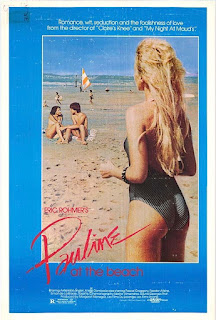
Pauline at the Beach [dir. Eric Rohmer]

Pauline is pretty, intelligent and thoughtful. Pauline listens more than she talks, and is less quick to judge than the people around her. Pauline is 15. The next installment in Eric Rohmer's Comedies and Proverbs series after The Aviator's Wife and A Good Marriage, Pauline at the Beach (PatB) is again an  unhurried exercise in characters speaking on and on and, somewhere in that process, revealing a little of themselves.

Pauline (Amanda Langlet) is holidaying in a seaside town with her older cousin, the glamorous Marion (Arielle Dombasle). Marion has just finished with her divorce, and the beginning of the film is quizzing Pauline about her love life. Pauline reveals herself to be a blank slate, not yet marked by any serious "affaires de coeur". While at the beach (a frequent location justifying its name in the title), they come across Pierre (Pascal Greggory), a former lover of Marion who still worships her and would like nothing better than for her to accept him. But Marion is no longer interested in Pierre romantically (certainly not the burning passion she wishes to experience in love), and his petty jealousy only puts her off. She is aroused by Henri (Feodor Atkine), an older more worldly-wise man they ironically meet through Pierre. But Marion wants an old-fashioned passionate romance and fidelity, and Henri, with his nomadic roving nature may not be willing to give her that. Apart from the menage-a-trois, there's also the teen Pauline meets at the beach, who she likes enough to hang around with.

Based on the films I have seen above, Rohmer's special ability is to take the exaggerated emotional situations of his characters and put it through a light of realism that exposes the absurdity or pettiness of it while still not making caricatures of them. In PatB, this is less successful than in the previous pictures.  I felt that the characters and situations were not as nuanced as the ones in The Aviator's Wife and A Good Marriage. This is most apparent in the section of the film where a misunderstanding occurs, inadvertently initiated by Henri and perpetuated by Pierre. It is a gauche device, that feels like it dropped in from some dated melodrama. To be fair, it is resolved in a quiet Rohmer-esque fashion (the last scene between Pauline and Marion is lovely), but it does stick out. Pierre's character is also half-drawn; his petty behavior makes it hard to ever appreciate his side of the story.

Of course, the main character here is Pauline, and as Amanda Langlet plays her under Rohmer's direction, comes off very well. We understand and appreciate Pauline as an intelligent adolescent girl who listens to several opinions, but ultimately goes by her gut feeling and makes her own decisions. She seems more balanced than the adults around her. On the whole a decent watch, but I am hoping for the further films in this series to be better.

Monday, November 29, 2021

The Wages of Fear [dir. Henri-Georges Clouzot]

In Le Salaire de la Peur aka The Wages of Fear, an unnamed heat-drenched fly-infested South American town is home to drifters from around the world. These are washed-up, lonely men whose consolations are cheap liquor and small stakes gambling at the local watering hole. When newcomer Jo (Charles Vanel) schmoozes in with his spotless white suit and big goombah manner, he creates a stir and makes an instant crony of the local tough Mario (Yves Montand), the men linked by memories of a shared neighborhood in France and a sense of macho camaraderie. Indeed, as soon as Jo appears, Mario ditches both his barmaid girlfriend Linda (Vera Clouzot, H-G's wife of the time) and his loyal roommate the cherubic and loquacious Luigi (Folco Lulli); yes, fans of a certain video-game franchise will be tickled, more so since Luigi's appearance is very like the iconic animated mushroom-stomping plumber.

Every migrant in the town is looking for a chance to make some proper money and get out of there. This opportunity comes up when an US-owned oil company fighting a blaze at its local drilling site puts out a call for truck-drivers willing to deliver a large shipment of nitroglycerine that will be used to snuff out the fire. There are no safety measures available to cart this lethal cargo, which is why the company is recruiting anonymous drifters whose deaths no one will follow-up on. But for the princely sum of 2000$ apiece, these men are willing to take the risk. Two trucks, each manned by two drivers, set out to traverse the distance to the oilfields: Mario and Jo make one pair, while Luigi and the taciturn German expat Bimba (Peter van Eyck) form the other.

It takes about an hour of the film's running time to lead up to this scenario, but once the journey starts it is almost the sole focus of the rest of the narrative. The men must ride night and day to reach the site in time. Their cargo is sensitive to heat and vibrations. The terrain is rough; paradoxically the trucks must move quick over the rockiest bits to minimize the jolts (references to keeping the speedometer above a certain level to avoid an explosive jerk will remind 90's kids of a certain Keanu Reeves starrer). There are serious obstacles, including a rickety plank bridge, an immovable boulder that blocks the road and later, a lake of crude oil that truck and men must traverse. 

The most interesting aspect of The Wages of Fear (based on a novel by Georges Arnaud) is the changing equation between its characters as they push forth in their hazardous course. Initially Jo is the heavy, the patron who twirls an eager Mario around his finger and bullies the other townsfolk with his revolver and his bravado. It is even suggested that he has 'eliminated' another fellow to be selected for the chance to earn the reward. But as the journey progresses, Jo's nerve gives way. He fidgets, he panics, he even tries to run away before he is dragged back by Mario, who grows increasingly disillusioned and contemptuous of the man he once deified. Both Vanel and Montand give their all to presenting the palpably credible transformation of their characters. In contrast Luigi, who had been earlier slapped around by Jo, throws off a cheerful courage and even the seemingly cold-hearted Bimba reveals an inner humanity. This is solid character drama wrapped around the mechanics of the tense suspense.

I do not agree with some of the criticisms leveled against Wages of Fear that the characters are shallow or that the film is unnecessarily bleak. Without spoiling events yes, it could have concluded on a more upbeat heroic note. But even if it is slightly overplayed in execution, there is nothing inherently wrong with the end as is, and it makes for a poignant conclusion for an equal parts thrilling and moving experience.


A few notes on my viewing experience:

More than a decade ago, a 148-min version of this film was released on blu-ray by the Criterion  label (described on their site as a 'New, restored high-definition digital transfer'), and that release was good enough for the time. Some time in 2017, a new 4K restoration of an even longer (152-min) version of the film sourced from the original camera negative was carried out. The UK release from the BFI is based on this restoration (I understand they postponed their previous 2016 release plans to avail of the new master). As expected (see screenshot comparisons), it is dramatically superior to the Criterion blu-ray in terms of image clarity, grain resolution and a much more refined contrast/gray-scale. Simply put, even if you own the Criterion blu-ray, this is a must-have upgrade (unless you want to wait for a possible 4K UHD announcement).

Friday, August 13, 2021

Le Doulos [dir. Jean-Pierre Melville]


The opening screen of Jean-Pierre Melville’s Le Doulos clarifies that the title is street slang for 'Hat-wearer' but it also refers to a police informant (what in vintage American crime slang is called canary or stool pigeon). But before we meet the Doulos, we are introduced to Maurice (Serge Reggiani), a gangster just out from prison. Maurice is uneasy about a new job, discussing it with a friend, a jewelry fence who seems to be very understanding and generous to him, willing to lend him money and even a gun...which Maurice then uses to shoot him.

Next we see Maurice being visited by his friend Silien (Jean-Paul Belmondo), a man everyone else seems to dislike / distrust. Silien has his own agenda, and he is also revealed to be Le Doulos in cahoots with the police. In a series of suspicious actions, Silien seems to be setting his friend up to be hauled in by the law, and also taking care of some other people to clear his own path. He is seen as a cold-blooded snakily ambitious sort with no scruples about how he achieves his aims. Later the film pulls out a dramatic reveal that wants us to re-evaluate many of the characters' actions.

Le Doulos is one of Melville’s early efforts in the crime genre he was best known for (Le Samourai, Le Cercle Rouge). We see the familiar stylistic tropes: The adoption of American noir fedora and trenchcoat fashions, the shadowy cinematography, the male bonding, the essential loneliness of the lead characters. But as a film, it comes across less smoothly. The twist reveal seems labored in its explanation, and some scenes like the one between Belmondo and Michael Piccoli are hard to swallow (you’d think a seasoned gangster would know an obvious frame-up and even at gun-point would realize that obeying the instructions would anyway lead to his death). The climax also seems more clumsy and drawn out, diluting the irony.

Le Doulos does have its good moments, like the shocker where a smiling Belmondo rough-houses “buddy” Maurice’s girlfriend (Monique Hennessy) for motives as yet unknown. The technical values are also fine for a low-budget independent production. On the whole this is still an interesting progenitor to, if not as well-constructed and smooth as, Melville’s later crime flicks.


Thursday, August 5, 2021

A Good Marriage [dir. Eric Rohmer]

While The Aviator's Wife (reviewed HERE) had a certain sweetness, A Good Marriage (Le Beau Mariage) - Eric Rohmer's second film in his Comedies & Proverbs series, falls into slightly disturbing territory.

Sabine (Béatrice Romand) is an almost pathologically wilful and impulsive woman. At the start of the story she decides, after her married lover takes a call from his family while they are having sex, to renounce the bohemian life and get married herself. Of course, it will have to be the ideal marriage to the ideal person. Sabine's best friend Clarisse (Arielle Dombasle) sets up a meeting with her cousin Edmond (André Dussollier), a good looking successful lawyer. In less than a couple of meetings, Sabine decides he fits the bill and tells all who will listen to her about the impending marriage, other than Edmond himself.


If it were to be made in 90's Hollywood, this would have been a Julia Roberts / Drew Barrymore starring rom-com vehicle and ended with the couple being joined in blissful matrimony. Thankfully, Rohmer's script is more nuanced: it recognizes the darker edges to Julia's self-obsessed worldview and there is a far more naturalistic vibe to both the development of her relationship with Edmond and its denouement. The only distracting factor is Clarisse, who seems to be blind to her friend's emotional insecurities and lack of perception towards other people while fixing a match for her.


A Good Marriage is still a comedy but a more restrained and observant one. Apart from the writing, the performances of the actors go a long way to carrying the drama, and the old-world French architecture seen in many of the outdoor sequences makes for a pleasant backdrop. I am not sure if I will revisit this one, but it is still a worthwhile watch.

Interesting vintage trailer that 'explains' the film to American audiences:


Tuesday, July 27, 2021

Hotel du Nord [dir. Marcel Carné]

Fair use, https://en.wikipedia.org/w/index.php?curid=22588108

In Marcel Carné's Hotel du Nord, young lovers Renée and Pierre (Annabella and Jean-Pierre Aumont) take a room at the titular canal-facing working-class hotel. It turns out they are not out for a spot of private necking, but for reasons not explicitly spelled out, a double suicide. After some flowery last words, Pierre fires a pistol at her, then chickens and runs out. Turns out she is not dead either, and recovers in hospital while he turns himself in to the cops. Renee does not bear a grudge but Pierre loathes himself and treats her meanly when she visits him in prison. In the meanwhile she earns her keep as a waitress at the hotel, where her good looks mean that she attracts the attention of other men.

The film also focuses on another pair of guests, Mme Raymonde (Arletty) – a middle-aged lady of the night – and her pimp and lover Edmond (Louis Jouvet, whose face bears some resemblance to the German star Conrad Veidt). They have a more cynical and tempestuous relationship, which generates a lot of the spice and humor of the film. Then Edmond falls in love with Renee in a manner that breaks through his hard-boiled front. Apart from these two pairs, there's an ensemble supporting cast composed mainly of the people staying in or working at the hotel.

If Hotel du Nord is one thing, it is romantic. This is most apparent in its treatment of the young lovers. Annabella as Renée was very obviously chosen for her ethereal looks, and she is always made up and photographed in the manner of classic Hollywood stars. There is an element of theatricality in the lines she shares with her lover. In contrast, the repartee between Mme Raymonde and Edmond has a street-wise staccato rhythm. The film plays indulgent observer to these couples and their interactions with each other and with the other characters.


Hotel du Nord
has all the hallmarks of a classic melodrama – romance, humor and tragedy – which it delivers with a sincerity and controlled passion that transcends cliche and keeps the viewer hooked. The actors nicely reflect the chemistry between their roles. There are some interesting nods, like a gay character who is referred to in a very progressive, non-judgmental way. The hotel and its immediate neighborhood, created on a set, make for a very well-etched setting. The cinematography (Louis Née and Armand Thirard) has luminous night-time visuals and there are some lovely overhead and crane shots, especially towards the end depicting the 14th of July celebrations. I was initially a little worried about whether it would not be a too old-fashioned maudlin drama, but Hotel du Nord is surprisingly nimble and manages to convey its air of doomed romance without a heavy-handed treatment.


Thursday, July 8, 2021

The Aviator's Wife [dir. Eric Rohmer]

About the movie-maker Eric Rohmer, a reliable friend told me, "If you like people talking, then you'll probably like his movies."

From my viewing of The Aviator's Wife (1981), the first in an episodic series of films he titled Comedies and Proverbs (C&P), that certainly feels accurate. It is very conversational in nature, with almost no pure visual or action scene. At the same time, it is not a stage-bound enterprise: many of the conversations take place in real locations / public spaces. In that sense, it is like the well-known Woody Allen films like Manhattan, Annie Hall etc. Of course, Woody was more of a visual stylist, working with skilled cinematographers Gordon Willis and Sven Nykvist. At least this film by Rohmer has a more plain and naturalistic feel, like the cinema vérité.

Our protagonist Francois (Philippe Marlaud), an insecure 20 year old in a shaky relationship with Anne (Marie Rivière) a beautiful older woman living by herself, is shaken when he sees her exiting the house with a former flame. Not having the gall to directly ask the girlfriend who treats him with a mixture of pity and contempt, he follows the ex-lover without a clear plan. In the course of this aimless spying, he comes across bubbly 15-year old Lucie (Anne-Laure Meury) who happily falls in with the scheme and even takes charge of the spying. They in turn have conversations where Francois slowly confesses his life to her, and she offers sometimes mocking, sometimes supportive opinions. At the end of the day, Francois visits Anne, who reluctantly lets him in her room, and they have a mini-showdown, in which she expresses her own sadness and frustrations.

All of this involves a lot of back and forth dialog. Lucky for us then that the writing is both interesting and natural-sounding. The characters feel layered and even when their flaws are exposed - Francois is immature and petty minded, and Anne is quite obviously not interested in any long term companionship with him - they are not caricatured. The Aviator's Wife ends of a note of ambivalent redemption.

Friday, December 11, 2020

Elevator to the Gallows [dir. Louis Malle]

Louis Malle's debut feature begins with a phone call where a woman (Jeanne Moreau) is planning with her lover to bump off her husband (who is also his boss), then meet with her at an assigned rendezvous. The lover carries off the killing, after he surreptitiously reaches the boss' chamber by climbing a rope with grappling hook, and rejoins his colleagues as they quit office for the weekend. But when about to drive off he realizes the rope he used is still hanging. To remedy the lapse, he again rushes into the building and is going up the elevator when the caretaker shuts off the power, leaving our man trapped inside.

Outside, his car is stolen by a blowhard delinquent and his girlfriend, who take it for a joyride. They find a gun in the glove compartment, and thus begins their own journey towards violence. Meanwhile, the woman waiting impatiently for the lover that didn't show up, trawls through their familiar haunts hoping to get news of him, only aware that she saw his car being driven away earlier with another girl in the passenger seat.

In terms of rational plot, Elevator to the Gallows is not always convincing. If the woman is having a secret affair, how is it that every bartender in town knows who she is going with? That would have been difficult to hide, especially from a husband who seems to be involved in arms dealing and some form of espionage. The behavior of some of the other characters also seems to be decided more by where the plot needs to go at a given moment rather than be an organic expression of their personality.

But it does not matter much because Elevator... is a film of style and attitude, and it delivers that in spades. Even when I am not convinced why, I can endlessly watch Jeanne Moreau walking the chiaroscuro Parisian streets at night with a smoky, downbeat Miles Davis trumpet in the background (the score is astounding, and reminds me of one of my favorite albums - Sunset Mission by Bohren & Der Club of Gore). Everyone is perfect in their parts (look for Lino Ventura turning up later as a detective). This may have been Malle's first fiction film (before this he worked on documentaries with Jacques Costeau), but his style is bold and consistent. Henri Decae's luminous B&W photography captures the claustrophobic confines of the elevator (and in a pulse-tingling moment, the shaft) and the gritty streets of Paris with equal flair, and Leonide Azar's editing is deft. Elevator... is a film I suspect I will be revisiting several times just to soak in its irresistible brand of elegant melancholy.

Saturday, June 8, 2019

Le Trou aka The Hole [dir. Jacques Becker]

What is it with the French and crime procedurals? They seem to have an almost innate talent at turning out kickass movies centering around criminals either carrying out a caper or escaping from custody. Jules Dassin's Rififi, Jean-Pierre Melville's Le Cercle Rouge (and any others I've missed), Claude Sautet's Classe Tous Risques. These often feature a set-piece where a delicate and risky maneuver is depicted in exquisitely excruciating detail, making the audience feel one with the participants and feel their tension. I am happy to have found Jacques Becker's Le Trou (aka The Hole) to be another proud member of this clique.

Becker's film was adapted from a book (written by José Giovanni) based on a true-life prison escape attempt. A group of men sharing a cell make an audacious plan to escape from their confines by digging their way into the underground sewer system from where they can tunnel out of the prison. Jacques Becker's commitment to capturing the realism of the event was so great he not only had sets built to closely correspond with the original locations and shot the prison cell scenes in an equally cramped and claustrophobic space, one of the major actors in the film (Jean Keraudy, he called himself) was a real-life participant in the original escape. Becker decided to use Keraudy after speaking with him and becoming extremely interested in the colorful inventive man, and decided to populate his film with non-professional actors.

Le Trou is almost entirely set in the confines of the prison. It begins with one of the characters entering as a new occupant in the cell already occupied by four men. After chatting with the new man, they decide to accept him as one of their own group and include him in their escape plan. The film covers each aspect of the escape with loving detail and an eye for realism. When floors and walls are dug through, they don't just break apart in a couple of blows, but take about as much effort as you would expect concrete structures to. Iron bars take a lot to be sawed across. Between each set of operations the gang has to be careful to wipe off or put away all traces of their covert activities. The film establishes a routine and constantly reminds us of it. In the wrong hands this could have ended up as a rote and boring exercise, but between the screenplay, the actors, the superb production design and strikingly austere B&W photography, we become one with the rhythm and are constantly riveted. When they break through into the sewer labyrinth and open a manhole to see the road outside the prison, there is a palpable sense of fresh air and freedom.

Do they actually manage to escape? I recommend you watch Le Trou to find out. But Becker's film is not just about the suspense. The prisoners are not action figures carrying out the motions. They have personalities and the relationship between them - trust, friendship, brotherhood - is equally important, in fact the lynchpin of the film's lasting impact.

Saturday, May 25, 2019

Emmanuelle [dir. Just Jaeckin]

Whatever I expected from a film described on the back blurb of the blu-ray case as "the seminal soft core porn classic", it certainly wasn't hearing a wholesale ripoff of legendary prog rock band King Crimson's Lark's Tongue in Aspic Part II used as a soundtrack theme. Stealing it was, but I have to admire the gumption of (ha!) composer Pierre Bachelet to imagine that gnarly intimidating track as a serenade to nearly every major sex scene in the film, and some of the reworkings using flute and acoustic percussion ain't half bad.


 For the rest, Emmanuelle sets the E(u)rotic movie pattern. The titular heroine (Sylvia Kristel, very easy on the eye) is the archetype fish out of water in exotic Thailand where she has come to join her husband Jean (Daniel Sarky) - as Roger Ebert describes in his review "a world of wicker furniture, soft pastels, vaguely Victorian lingerie, backlighting, forests of potted plants, and lots of diaphanous draperies shifting in the breeze". Add to that description, a batch of native servants who like to spy on their employer's sexual activities and in turn carry out their own physical comedies.

Jean claims to want Em to not feel tied to him, and to try out any sexual experiments she wants. But it would appear in fact that little Jean wants her to be liberated only in the shallow unromantic manner he and his society of expats indulge in. When she ignores the clique of bored grope-happy neighbors and falls for a winsome lady archeologist (Marika Green), he shows himself a jealous husband like any other. Sylvia's scenes with Marika are some of the best in the film, sexy, funny and carrying a palpable sense of romance. Most of the sex thus far is of the tame variety, pleasant to look at without being outright fap material (unless you're in your teens, in which case little isn't).

After she is sent off by Marika, Em returns to Jean who then coaxes her to go with aging Casanova Mario (Alain Cuny). Mario looks somewhat like David Lynch and talks like you would expect Lynch to, if you knew him only from his movies, a lot of solemn balderdash. Mario's ideas of sexual liberation take the film into queasy territory, including a gang rape sequence and later one where Em is made the prize of a Thai boxing bout. She accepts these situations with questionable equanimity and we must believe that they contribute to her erotic awakening. Maybe it's just me, but I find the frank exploitation scenes of Zakhmi Aurat or Savage Streets more palatable than such arty rape fantasies.

Still, for most of its running time, Emmanuelle is a pleasant trip with good looking actors, ravishing locales, lovely soft focus photography (Richard Suzuki)...and yes, large swathes of Larks Tongue in Aspic Part Sex.

Wednesday, August 1, 2018

The Confession [dir. Costa-Gavras]

From the director of the political thriller Z (which was also adapted in 2012 by Indian film-maker Dibakar Banerjee as Shanghai), The Confession is another film which looks at corruption endemic to power. It is based on the book written by Czech communist politician Arthur London. Played by French movie star Yves Montand, the film looks at how London, appointed as a deputy minister of foreign affairs just 2 years prior, is suddenly brought in for questioning about his past dealings and accused of being a traitor to the ideals of the ruling communist party. The interrogation, dealt with in great detail, is really more a process of extended torture. Made to keep walking inside his cell, barely allowed to sleep or eat, an increasingly disoriented London is alternately yelled at or coaxed by his tormentors to confess to deliberate treason against the state. Initially London denies the charges vehemently, confident that his basic innocence and his political connections will soon lead to his release. But they are relentless, breaking down his emotional defences, chopping up his testimony to individual sentences and then rearranging them to suit their purposes. London and several of his colleagues are put up for what is called a show trial, one where the guilt of the accused has already been decided and the court proceedings are merely to make a strong example of them. As part of the notorious Stalinist purges, of the 14 people accused at this trial, 11 were executed and 3 - including London - sentenced for life. He was released 2 years after Stalin's demise.

Inherent to the nature of the film, there is a lot of repetition: we see day after day London undergoes repeated cycles of torture. He is held for months without official charges under emergency law where his persecutors have extraordinary powers. When London's wife (Simone Signoret) protests about her husband's abduction in the ministry, their house is seized and she has to take employment in a factory. By the time they have compelled him to sign on practically fabricated confession he has been reduced to a pale thin shadow of his former self (Montand lost 23 pounds over the course of shooting). Then in the period towards the trial they reverse the process, feeding and medically administering to him ("preparing the goose" London remarks), even using a lamp to give him an artificial tan, masking his continuous isolation. The film is powered by Montand's performance, but it's a performance wholly in service to the strong statement the director wants to make.

Gavras sometimes uses a non-linear style going back and forth in London's life. It is suggested that some of the trials he presided over may have obtained confessions of guilt using the same methods he is now subject to. Regardless of ideology, the people in power are invariably corrupt and hostile paranoia increases the more one climbs the ladder of political rule.

Tuesday, March 27, 2018

Le Plaisir [dir. Max Ophuls]

The screenplay for Le Plaisir is sourced from 3 short stories by the celebrated author Guy De Maupassant - The Mask, The House of Mme Tellier and The Model.
The Mask opens with a ballroom dance entertainment to which all of gay society seems attracted. A man wearing the mask of a bohemian toff rushes in and sways wild on the dance floor till he suddenly drops. A doctor takes off the mask to find an old man beneath, and after first aid, undertakes to escort him home. It turns out the old man was a dandy in his youth, much sought after by the womenfolk. He wears the mask to barge into dance-halls to relive his naughty youth. Ophuls tells the story with the pithiness it requires for impact, and the vigorous camerawork in the dance-hall sequences is a delight.
The House of Mme Tellier aka Le Maison Tellier, the longest running episode in this triptych, is an amusing social comedy of what happens when the ladies of a respected brothel go on a suddenly announced holiday to the countryside. There is an uproar amongst the townsmen with their weekend boredom and frustration leading to quarrels ("This is how wars start", one character notes). On the other hand, the ladies, who are attending the communion of Mme Tellier's niece, have an emotional quasi-religious experience in the village church during the ceremony. There is also the sub-plot of Mme Tellier's brother Joseph (Jean Gabin) having less than honorable intentions towards one of her ladies, culminating in a drunken episode. There is observation of social mores, the endearingly friendly relationship between the ladies and their clients (was this true of the time? who knows?), the amusement from contrasts of the characters. When Joseph's playful flirtations cross the line into sexual transgression, he is immediately contrite and apologizes to the women, recognizing their dignity. This was my favorite episode, wonderfully acted and directed with subtlety and a delightful lightness of touch. There are some fantastic pans and tracking shots, like towards the beginning of the film where Ophuls explores Mme Tellier's House through its various doors and windows. I do wish he could have shot this episode in color. The visuals of the countryside were crying out for some technicolor goodness and the scene in the train where the ladies are being seduced by a salesman of colorful garters has less impact in grayscale, IMO.
The Model is to my mind a lesser story and thankfully relegated to a short quarter of the film. An artist falls in intense love with a model and they stay together, only to find differences of temperament that lead to quarrels. He moves out, no longer interested in the relationship. When she threatens to commit suicide by jumping off a building, he dares her, only to find that she is actually capable of the deed. The fall leaves her legs permanently damaged, and either in recognition of her act of adoration or the guilt of being responsible for her condition, he marries the crippled woman and devotes his life to her care. Even with the brevity with which it is shot, there is an element of shrill melodrama that's less interesting than the clever and observant episodes that came before.

Tuesday, March 22, 2016

Chantal Akerman special

On Sunday, I saw a couple of Chantal Akerman films as part of an appreciation at the local Liberty cinema.

First was Jeanne Dielman...[long title giving the name & address of the protagonist]. At 200+ min, the majority of it devoted to scenes of a homemaker doing her chores almost in real-time, it's jumping off at the deep end as an introduction to a director. Based on reputation I was all prepared to pronounce it as pretentious and dull, but the film has a rhythm and a reason for its structure. Day 1 can be interpreted as the last of the woman's orderly if dull existence. We see her wholly a creature of routine, her life devoted to accomplishing a series of tasks, be it cooking dinner, polishing her son's shoes, babysitting a neighbor's infant or sleeping with a regular client for money, all with the same unemotional precision. Day 2, we see a repetition of those tasks but with slight instances of disorder, like a tiny crack on a window, creeping into her routine, suggesting a long gestating mental breakdown. Day 3 shows those cracks spidering ever so little more, until we reach an abrupt startling crescendo

🚫[spoiler]where she stabs that day's client with a pair of scissors. It is shown that she gets an orgasm during sex prior to that and is therefore perhaps disturbed by her emotional involvement. I felt so, but not sure[/spoiler].🚫

The rhythm is what defines the film, stick with the first half hour or so of the film and it will suck you in. The differences in Day 2 will further intrigue you as to where the build-up is leading to, and the film doesn't disappoint in its culmination. There are instances where the film tests your patience, with 5 min static shots of the protagonist staring into space, but even if indulgent they make sense within the context of the film's thrust. I would urge people to see this film.


The other Akerman effort I saw was Je Tu Il Elle (I/You/He/She). It is at 86 min a brief venture. Although released in the same year as Jeanne Dielman, it carries far more of a student film feel. The opening segment has Akerman monologuing in stream of consciousness mode while we see her sleeping / writing / binging on sugar, all with / without her clothes on. The middle segment has her hitching up with a trucker who takes care of her. Apart from his instructing her in giving him a handjob we don't see any overt evidence of sexual interaction between them. There's a really good monologue (taken in a single shot, IIRC) in this section where the trucker rambles on about his married life and the routine it has been reduced to. It's a lot more comprehensible and easy to empathize with than the intellectual garbage of the first segment. In the concluding act of the film, Akerman joins up with a former girlfriend, with who she behaves in a terribly boorish fashion before proceeding to have vigorous sex with (a precursor to the sex scenes in Life of Adele). The end. My opinion: Akerman has a sexy Venus-like figure she fully exploits, but the film itself is prententious crap IMO.

There was also a 10-min short La Chambre (The Room), which is just a series of 360 degree pans around a 2 room apartment where the only change comes in the position and activity of the woman on the bed. If there was something to be made of this, it missed me entirely.

Sunday, August 25, 2013

La Grande Illusion [dir. Jean Renoir]

Last night I saw La Grande Illusion. This is a 1937 movie about French soldiers captured by the Germans during WW1. There are several occasions in which the French soldiers try to escape their prisons, the ideas for which were later taken for several "escape" films. But this is not purely an escape movie. The film casts an observant eye on the class differences between the soldiers (especially between the noble-born officers and working-class soldiers) and how these differences are to them greater than the differences in nationality or religion. The movie does not explicitly show the cruelties of war, and the interaction between the prisoners and their German soldiers is generally of a chummy nature or at least showing mutual respect (most striking here is the cameraderie between Pierre Fresnay as the highborn French officer de Boeldieu and Erich Von Stronheim as the aristocratic German captain von Rauffenstein). Rather, it depicts the futility of war by showing how the people involved in fighting these wars do not have any inherent hatred or ill feeling towards each other, and it is the arbitrariness of those in power that pulls them into conflict. While La Grande Illusion is on the sentimental side, it is not preachy. There is a cautiously optimistic message that at the end of the war, people will once again learn to live with each other. Of course, this hope was undone 4 years after the film was released with the advent of WW2.
La Grande Illusion was banned in Germany and Italy (of course), but was a major success wherever else it was released. Audiences identified with the essential decency of the characters and the anti-war sentiment. A cross-border love story that blossoms towards the end of the film is especially poignant. I would really like to see India make a war-time film like this instead of just the ones that go rah rah patriotism.

Studio Canal's blu-ray of La Grande Illusion features an impeccable presentation. Unlike the previous Criterion DVD release which from screenshots now appears digitally sharpened and cropped on all sides, this BD uses a newer 4K restoration sourced from the nitrate negative and the image is simply stunning. Terrific depth, deep (but not boosted) blacks and such minimal grain that one could almost suspect noise reduction if not for the terrific detail. There are occasionally soft scenes but none that seem a by-product of digital manipulation. The French audio track (DTS-HD MA 2.0) is clear and does the job, though as expected for a movie of this vintage, not especially immersive and the highs in the background score jar a teensy weensy bit for me. There's a boat load of extras which promise to be interesting, but I have not seen any other than the (very nice) lengthy video introduction/essay by French movie critic Ginette Vincendeau (who seems to be the go-to person for video essays on Arrow and Studio Canal releases of French movies).

Friday, October 15, 2010

The Science of Sleep [Michael Gondry]

The Science of Sleep, if cut down to its barest outline, can be described as a romantic story about two people who discover interesting things about each other and want to be together. Stephane is a graphic artist persuaded by his mother to live with her and take up a nearby job, which he discovers is the distinctly mundane task of pasting type-faces on to calendars. His neighbor Stephanie is an artist herself. After their chance encounter Stephane's initial interest in her is more due his attraction to her friend Zoe, but he slowly discovers that the low-profile and sexually disinterested Stephanie has her own charms.

This could be a conventional date movie about how the underdog wins, but Gondry introduces some unique viewpoints which take it far above the mundane. First, Stephane is torn between the real world and a fantasy world where anything can happen. Gondry himself does not bother about strictly differentiating these two worlds and cheerfully segues from one into the other. The fantasy elements give Gondry free rein to express his own trademark visual sensibility, with deliberate lo-fi effects that exude their unique charm. Thus we see Stephane flying over swaying buildings or riding with Stephanie on a stuffed toy horse or sailing on a forest-covered boat in an ocean of cellophane, all essayed with a warmth that would have been impossible to convey using the conventional photo-realism obsessed brand of CGI or that overused 'Tim Burton style'.

Up to this was very much expected. But what pleased me far beyond was Gondry's writing. In Stephane and Stephanie, he has created characters that are non-stereotypic and very empathic human beings; we genuinely like them even as we are made aware of their respective flaws. In a lesser movie Stephane's idiosyncrasies would have been translated as a cuteness factor that endears him to other stock characters. Here we have no doubts that any emotional relationship between him and Stephanie will have its share of troubles. Even at the end the status of their equation is ambiguous; we are given no assurance that their association will go beyond heartfelt friendship. It is to Gondry's credit that we appreciate this ambiguity and do not as an audience ask for a forced resolution. While the leads are terrific, the film also has an interesting set of supporting characters that add to the humor and charm of the experience.

To sum up, The Science of Sleep is a terrific emotional experience that no one who likes off-beat narratives should miss. It is also a great date movie, and one you do not have to leave your intelligence at the door for.