Thursday, December 30, 2021

Pauline at the Beach [dir. Eric Rohmer]

Pauline is pretty, intelligent and thoughtful. Pauline listens more than she talks, and is less quick to judge than the people around her. Pauline is 15. The next installment in Eric Rohmer's Comedies and Proverbs series after The Aviator's Wife and A Good Marriage, Pauline at the Beach (PatB) is again an  unhurried exercise in characters speaking on and on and, somewhere in that process, revealing a little of themselves.
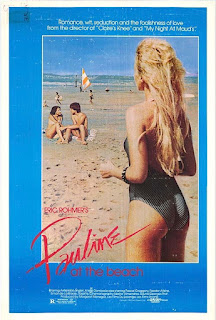
Pauline (Amanda Langlet) is holidaying in a seaside town with her older cousin, the glamorous Marion (Arielle Dombasle). Marion has just finished with her divorce, and the beginning of the film is quizzing Pauline about her love life. Pauline reveals herself to be a blank slate, not yet marked by any serious "affaires de coeur". While at the beach (a frequent location justifying its name in the title), they come across Pierre (Pascal Greggory), a former lover of Marion who still worships her and would like nothing better than for her to accept him. But Marion is no longer interested in Pierre romantically (certainly not the burning passion she wishes to experience in love), and his petty jealousy only puts her off. She is aroused by Henri (Feodor Atkine), an older more worldly-wise man they ironically meet through Pierre. But Marion wants an old-fashioned passionate romance and fidelity, and Henri, with his nomadic roving nature may not be willing to give her that. Apart from the menage-a-trois, there's also the teen Pauline meets at the beach, who she likes enough to hang around with.

Based on the films I have seen above, Rohmer's special ability is to take the exaggerated emotional situations of his characters and put it through a light of realism that exposes the absurdity or pettiness of it while still not making caricatures of them. In PatB, this is less successful than in the previous pictures.  I felt that the characters and situations were not as nuanced as the ones in The Aviator's Wife and A Good Marriage. This is most apparent in the section of the film where a misunderstanding occurs, inadvertently initiated by Henri and perpetuated by Pierre. It is a gauche device, that feels like it dropped in from some dated melodrama. To be fair, it is resolved in a quiet Rohmer-esque fashion (the last scene between Pauline and Marion is lovely), but it does stick out. Pierre's character is also half-drawn; his petty behavior makes it hard to ever appreciate his side of the story.

Of course, the main character here is Pauline, and as Amanda Langlet plays her under Rohmer's direction, comes off very well. We understand and appreciate Pauline as an intelligent adolescent girl who listens to several opinions, but ultimately goes by her gut feeling and makes her own decisions. She seems more balanced than the adults around her. On the whole a decent watch, but I am hoping for the further films in this series to be better.

Friday, December 24, 2021

2021: Endgame

Now that the year will be coming to an end in another week, 'tis time to continue the saga of movie opinions. I'm laying down my summarized views of 2021 movies I saw between Aug-Dec 2021 (My take on 2001 Jan-Jul movies HERE).

Shershaah (Hindi, Amazon Prime) As a film, this biopic comes off all too formulaic and pat, with the shallow feel of an overlong army recruitment promo rather than the emotionally involving saga of a brave warrior.

#Home (Malayalam, Amazon Prime) Shallow as an ad-film for a retirement finance plan, yet stretching to a vegetative 160 min, this one wallows in blandness. Too many characters introduced without giving them enough to do. The actors are almost uniformly solid (Indrans shines as the mild mannered indulgent father), but the script foundations are too weak and shaky for this #home to stand up. Site review HERE

Bell Bottom (Hindi, Amazon Prime) While the bulk of Bell Bottom suffers from Akshaykumarism and all that the syndrome implies, it's actually less of a wince-fest than the other movies he has done in recent past. There are occasional sequences where the film springs to life, holding true to its 70's Bollywood hailing spirit. With an actor who has less of an off-screen agenda this could have been a significantly more entertaining movie.

Aarkkariyam (Malayalam, Amazon Prime) Aarkkariyam may be described as a moral mystery with a warm humanist streak. The film errs on the side of rambling, but it is avoids unnecessary dramatics or that dreadful habit of superfluous twists that destabilize the narrative. Beautiful writing and performances make it worth recommending at least as a once-watch. Site review HERE

Shang-Chi (English, Hotstar) Up to about halfways, Shang-Chi and the Something Something was fakking boring. Even after that it never achieves greatness but Ben Kingsley has fun and the climax (with its nods to Return of the Jedi's father-son lighsaber duel) generates sufficient enthusiasm to meet the threshold for a boilerplate marvel feature.

A Ghost Waits (English) While the movie (which mixes elements of The Ghost and Mrs. Muir with Beetlejuice) was pleasant, it was never more than that. There is a sweetness to the romance element, but I felt the makers should have put more bite into the scare and humor segments and not have them be so timid / perfunctory as to be nondescript. Decent as a one-time watch (I saw it on the Arrow blu-ray).

Jai Bhim (Tamil, Amazon Prime) This is reminiscent of 90's Indian movies that mixed scenes of gruesome torture / violence with mainstream masala sentiment. The victims have little personality other than being innocent oppressed folks, and the bad guys are cardboard evil. For a film that so obviously fictionalizes many elements of its story, they could have tried to come up with more interesting writing.

Ghostbusters: Afterlife (English) Notable as my first post-lockdown cinema trip. This was a decent fun experience. It succeeds in keeping the fan service at a tolerable level and concentrating on giving likable characters (played by wonderfully cast young actors). It also, succeeds, without banging too hard on cheap references, to generate the sense of adventure Hollywood PG-13 movies had in the late 70's and 80's.


Still need to see (and would love to get more recommendations from y'all):

Thinkalazhcha Nishchayam, Churuli

Monday, November 29, 2021

The Wages of Fear [dir. Henri-Georges Clouzot]

In Le Salaire de la Peur aka The Wages of Fear, an unnamed heat-drenched fly-infested South American town is home to drifters from around the world. These are washed-up, lonely men whose consolations are cheap liquor and small stakes gambling at the local watering hole. When newcomer Jo (Charles Vanel) schmoozes in with his spotless white suit and big goombah manner, he creates a stir and makes an instant crony of the local tough Mario (Yves Montand), the men linked by memories of a shared neighborhood in France and a sense of macho camaraderie. Indeed, as soon as Jo appears, Mario ditches both his barmaid girlfriend Linda (Vera Clouzot, H-G's wife of the time) and his loyal roommate the cherubic and loquacious Luigi (Folco Lulli); yes, fans of a certain video-game franchise will be tickled, more so since Luigi's appearance is very like the iconic animated mushroom-stomping plumber.

Every migrant in the town is looking for a chance to make some proper money and get out of there. This opportunity comes up when an US-owned oil company fighting a blaze at its local drilling site puts out a call for truck-drivers willing to deliver a large shipment of nitroglycerine that will be used to snuff out the fire. There are no safety measures available to cart this lethal cargo, which is why the company is recruiting anonymous drifters whose deaths no one will follow-up on. But for the princely sum of 2000$ apiece, these men are willing to take the risk. Two trucks, each manned by two drivers, set out to traverse the distance to the oilfields: Mario and Jo make one pair, while Luigi and the taciturn German expat Bimba (Peter van Eyck) form the other.

It takes about an hour of the film's running time to lead up to this scenario, but once the journey starts it is almost the sole focus of the rest of the narrative. The men must ride night and day to reach the site in time. Their cargo is sensitive to heat and vibrations. The terrain is rough; paradoxically the trucks must move quick over the rockiest bits to minimize the jolts (references to keeping the speedometer above a certain level to avoid an explosive jerk will remind 90's kids of a certain Keanu Reeves starrer). There are serious obstacles, including a rickety plank bridge, an immovable boulder that blocks the road and later, a lake of crude oil that truck and men must traverse. 

The most interesting aspect of The Wages of Fear (based on a novel by Georges Arnaud) is the changing equation between its characters as they push forth in their hazardous course. Initially Jo is the heavy, the patron who twirls an eager Mario around his finger and bullies the other townsfolk with his revolver and his bravado. It is even suggested that he has 'eliminated' another fellow to be selected for the chance to earn the reward. But as the journey progresses, Jo's nerve gives way. He fidgets, he panics, he even tries to run away before he is dragged back by Mario, who grows increasingly disillusioned and contemptuous of the man he once deified. Both Vanel and Montand give their all to presenting the palpably credible transformation of their characters. In contrast Luigi, who had been earlier slapped around by Jo, throws off a cheerful courage and even the seemingly cold-hearted Bimba reveals an inner humanity. This is solid character drama wrapped around the mechanics of the tense suspense.

I do not agree with some of the criticisms leveled against Wages of Fear that the characters are shallow or that the film is unnecessarily bleak. Without spoiling events yes, it could have concluded on a more upbeat heroic note. But even if it is slightly overplayed in execution, there is nothing inherently wrong with the end as is, and it makes for a poignant conclusion for an equal parts thrilling and moving experience.


A few notes on my viewing experience:

More than a decade ago, a 148-min version of this film was released on blu-ray by the Criterion  label (described on their site as a 'New, restored high-definition digital transfer'), and that release was good enough for the time. Some time in 2017, a new 4K restoration of an even longer (152-min) version of the film sourced from the original camera negative was carried out. The UK release from the BFI is based on this restoration (I understand they postponed their previous 2016 release plans to avail of the new master). As expected (see screenshot comparisons), it is dramatically superior to the Criterion blu-ray in terms of image clarity, grain resolution and a much more refined contrast/gray-scale. Simply put, even if you own the Criterion blu-ray, this is a must-have upgrade (unless you want to wait for a possible 4K UHD announcement).

Monday, November 15, 2021

Pink Floyd - The Wall [dir. Alan Parker]

The Wall here refers to the 1982 film adaptation of the phenomenal Pink Floyd album directed by Alan Parker. The script was written by the band's main rudder of that era, Roger Waters, and is partly autobiographical: The lead character, a rock star named Pink (a trans-continental phone call he makes refers to him as Mr. Floyd), who in the midst of a successful career is a drugs and alcohol addled recluse disconnected from the world around him. We go into Pink's past as a lonely child whose father died as a soldier in WW2. Between an over-protective mother and an uncaring educational system (compared here to a meat-grinding machine), Pink grows up so emotionally stunted he cannot hold on to any relationship, and becomes incapable of forming new ones. He seems to spend all his non-working time watching TV, specifically re-runs of the populist British war film The Dambusters (apparently a favorite of Waters)

Waters originally conceived The Wall as a cinematic extension of the album that would incorporate footage from the planned live performances and animation sequences by the brilliant Gerald Scarfe. That idea changed as development moved ahead. Once Alan Parker was attached to direct the project, he convinced the team to drop the idea of using any stage footage of the band, and commit to the reality of the film's setting. Originally Waters was to play the lead himself, but the job went to another musician Bob Geldof, who fully commits to the craziness of the part without any sympathetic concessions (apparently one of Waters' bugbears with the film, and at least partly responsible for a very acrimonious working relationship between him and Parker).

Going back and forth in time, and slipping fluidly between reality and dream, The Wall is like an feature-length music video (long before concept-oriented music videos were a thing). There are astounding juxtapositions of live action with Scarfe's nightmarish animated drawings; the most startling one is when a woman's shadow on the wall morphs into a monster that terrorizes Pink. It may be remembered here that this was long before CG was used to any meaningful effect in films, and achieved purely by a mix of practical and optical techniques.

Watching the film and hearing its soundtrack so many years after the last time I played the album, I once again came to appreciate the brilliance of The Wall as a work of art. The album's ubiquitous popularity has of course led to a bunch of people calling it overrated, and I won't deny getting a little sick of the number of times Another Brick in the Wall Pt 2 played on MTV, but once you've allowed a little distance, the emotional charge of Waters' lyrics and the band's fantastic musical sensibilities hit you right in the chest. Several critics have complained that the film is just a sensory showcase with little depth, but I felt that the emotional sub-text comes across well enough. I am not entirely sure of Pink's fascist fantasy in the last act of the film, but I did not find that a serious drawback, and between the lead acting (even Klaus Kinski would have had a pause at Geldof's crazy turn) and the constantly inventive chutzpah on display, the film remains interesting up to the end.


PS: The Wall is an interesting comparison to Tommy, another rock opera by a talented egoistic artist: Pink Floyd's album is more consistently brilliant, especially because it knows when to draw its curtains. Similarly, Parker's film adaptation of The Wall makes for a far more watchable and engaging experience than Ken Russell's "Let's fling all manner of shit and see what sticks" approach to the film of Tommy.

Tuesday, November 9, 2021

The Green Man [dir. Robert Day]

In a story that triggers brief memories of Ealing Studios' (ha!) killer comedy Kind Hearts and Coronets, The Green Man's protagonist (Alistair Sim) is an unprepossessing assassin who specializes in bomb hits. The story starts with our bomber giving a self-laudatory account of his career, leading up to his latest endeavor in progress - giving an explosive sendoff to a pompous politician when the man is at an incognito weekend getaway. 

Unfortunately the mousy secretary Sim had been pretending to court, to get info on his target's movements, becomes suspicious and insists on an explanation. Rather preposterously, she decides the best way to do this is to go alone to the home of the man she suspects of ulterior motives. Now Sim must silence her before she can spill the beans. For this he arranges to lure her into the heretofore untenanted neighboring house and dispatches his not entirely trustworthy assistant (John Chandos) to finish the job.

But in what seems the beginning of bad luck for him, the new tenants (Jill Adams and Colin Gordon) choose that very day to move in, and there's also a pushy vacuum cleaner salesman (George Cole). This leads to a merry rigmarole in which the characters run helter-skelter and even the corpse seems to have a life of its own. The final showdown is in the titular Green Man hotel, where the bomb is supposed to go off. Will Sim's plan succeed or will his neighbors be in time to stop it?

If you like classic dry British humor, there is much to enjoy in The Green Man. It is all very silly and not remotely believable, but that doesn't stop the film from being fun. In the script by Sidney Gilliat and Frank Launder (of The Lady Vanishes fame), there seems to be a mischievous skewering of the snooty class, with characters called Upshott, Willoughby-Cruft and (really now) Boughtflower being the target of a lot of the humor. Alistair Sim is a consummate comic actor, carrying off his scenes with aplomb, and George Cole (who in real life was a protege of Sim) as the bumbling but dogged appliance pusher is an excellent foil. The much-loved British character actor Terry-Thomas as the Boughtflower character has a rather smaller role than one would have liked (he would have been excellent as the pompous politician target).

The film was also produced by Gilliat and Launder, who had a great regard for Alistair Sim. In fact it is said Robert Day (previously a camera operator) was a director more in name than deed, and the film was ghost-helmed by Sim (with some uncredited aid from Basil Dearden, who is seen directing  the cast in behind the scenes stills of the film).

For those interested, a few words on the UK blu-ray edition from Studio Canal:

The blu-ray gives an excellent clean presentation of this vintage movie with nice filmic detail and good contrast. The mono sound is limited by the source material (don't expect any floor-rattling explosions, and there is some hiss) but clear enough for the dialog which is the main thing. Extras include 3 approximately half-hour featurettes (plus a short photo gallery video)

Monday, October 25, 2021

One of Our Aircraft is Missing [dirs. Powell and Pressburger]

While not the first collaboration between the great team of Michael Powell and Emeric Pressburger, One of Our Aircraft is Missing (OOOAIM) was the first official production of their brainchild The Archers, in which they took a joint writer-producer-director credit. So it is an important element of film history. Lucky then it's an entertaining film too, especially interesting to fans of old-school war dramas (of course, OOOAIM wouldn't have been old-school but quite cutting edge in 1942 when it was released).

The film deals with a British bombing mission over Stuttgart that goes awry when the plane is hit by retaliatory fire and the 6-man crew are forced to bail out in their parachutes. They drift into a neighboring region of The Netherlands. The danger is far from over because this is still Nazi-occupied territory. They must rely on the patriotism of the native Dutch people and their resentment of the Nazi invaders to reach back home. The rest of the film is an episodic narrative where they are passed from one group of locals to another, all coming together to aid the Brits who they hope will ultimately help in eliminating the Nazi tyranny. It is a little piecemeal but the brisk pacing does not leave much time to reflect.

The focus of the screenplay is less on military heroics and more on solidarity between people against Nazi oppression, and cooperation for a common cause. Although OOOAIM primarily deals with the all-male British bomber crew, Michael Powell influenced Pressburger to write strong female parts, and so among the Dutch locals they meet some fierce women who are instrumental in arranging for the help they need; my favorite was Googie Withers' portrayal of the no-nonsense Joe de Vries who fools the Nazis into believing that she is friendly to them, all the while sheltering and aiding stranded allied forces. Powell's. autobiography claims that Googie, who had Dutch roots, was so overcome at being offered the part she broke down.

Technically too, the film is a marvel. Apart from exciting footage of actual planes obtained with help from the British armed forces, art director David Rawnsley designed massive floor-spanning miniatures of the Stuttgart landscape to depict the bombing run. Ronald Neame's cinematography is evocative and the film is skillfully edited by a young David Lean (just prior to his directorial debut with In Which We Serve). Powell also decided to avoid any background score and employ only digetic music, which generated a more realistic tone, while also highlighting the emotion when specific music cues like the Dutch national anthem were used. OOOAIM is old-fashioned in terms of its portrayal of war where soldiers could still be shown to be chivalrous and fair-minded, but it does not appear creaky.


Tuesday, October 19, 2021

Thupparivaalan aka Detective [dir. Mysskin]

A dedication at the start of Thupparivaalan salutes Arthur Conan Doyle, Sherlock Holmes and 'the mercurial' Jeremy Brett. But the detective hero of Mysskin's movie owes more to the rude arsehole of the Robert Downey Jr. interpretation. 'Action' star Vishal is Kaniyan Poongundran, the archaically named moody sleuth that 'rebels at stagnation' (in the hero introduction scene he stomps all over his book-lined apartment, petulantly demanding to be given a challenging case). He behaves like a  perfect tyrant with almost everyone, but most notably his 'Watson' Manohar (Prasanna) who seems a loser with no life of his own.

Kaniyan takes up the case of a schoolboy whose family dog was murdered, but the matter quickly escalates to a more sinister degree, involving a gang of assassins-for-hire (including a near-unrecognizable Bhagyaraj) who come up with some truly outre ways of carrying out their hits. The plot is all over the place, but Mysskin's writing delivers some ingenious fun moments, like when the killers carry out a Rube Goldberg scheme of offing a target with the help of nitrous oxide aka laughing gas - this would not be out of place in a Denny O' Neil - Dick Giordano 70's era Batman comic (for some reason, all mentions of nitrous oxide are bleeped out in the soundtrack, as though they were threatened with legal action by the gas manufacturers). Kaniyan's incongruous golf cap and ascot - standing in, one supposes, for Holmes' deerstalker and pipe - and the throwaway references to Tamil pulp fiction detective Sankarlal and Stanley Kubrick raise chuckles as well.

Thupparivaalan becomes less interesting in the bigger picture. The villains bandy a generic ruthlessness (the leader takes a coffee break in the middle of chainsawing a corpse, whoop-de-whoop), the 'HERO' action scenes and location hopping chases lose the idiosyncratic touch (although one of them ends in a memorably crazy Seppuku sequence). Also, Kaniyan's treatment of the token romance (a simpering Anu Emmanuel) is risible. But even while commercial, this film has more of the Mysskin personality than his Mugamoodi and is a decent watch for fans.