Showing posts with label animated. Show all posts

Saturday, December 27, 2025

Tokyo Godfathers [dir. Satoshi Kon]

Occasional violence notwithstanding, Tokyo Godfathers - Satoshi Kon's 2003 Xmas themed movie - is his most family-friendly effort. The title is a hat-tip to John Ford's 1948 Western Three Godfathers, in which a trio of thieves led by John Wayne are landed with the care of an orphaned infant.

Kon's heroes are three hobos that find the baby while scavenging in a dumpster. Hana the melodramatic transgender is overjoyed at the prospect of being a 'mother' although it is soon clear that she is less prepared for the practicalities than the middle-aged taciturn alcoholic (ha!) 'Gin', who has a tragic backstory that may not necessarily be true. Rounding out the trio is morose teenage runaway Miyuki.

Initially, Gin and Miyuki want to hand the baby girl over to the police, while Hana - who names the child Kiyoko - is determined to raise her, even if it means striking out on her own. They reach a compromise in deciding to hand the girl back to her parents using the meager clues they find to their identity. Their winding journey includes meeting a mafioso, bearing witness to an assassination and learning about a former bar girl that may be Kiyoko's mother. In this process they also learn more about each other and about their own selves.

Kon is normally known for bizarre dream-logic enterprises like Perfect Blue, Paprika and his series Paranoia Agent. His 2001 fictional biopic Millennium Actress - which traces the life of a former film star, and in the process gives a history of the Japanese film industry - was the closest he had till then got to a conventional drama. Tokyo Godfathers is again a more grounded narrative, remaining in a real world, albeit one with some very colorful characters. While Kon does not sugarcoat the melancholy of his characters, this is ultimately a film of hope, and that is what Xmas season is all about, isn't it?


Tuesday, January 18, 2022

GRIS

Un-kvlt has become so much a movie opinions blog it is shocking to even myself when I add other content. But I have previously done game impressions so this is not entirely unheard of.

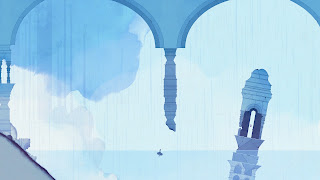
GRIS is one of the few video games where the end is a sad place to reach because you feel you could have stayed on a lot longer in the gorgeous world. You could take a screenshot just about anywhere in this surreal 2D platformer with light puzzle elements and it'd look like a frame-worthy work of art. The soundtrack is minimalist but very soothing and emotional in parts. Add to that a VERY forgiving learning curve - no dying, no hard boss fights, no requirement of super-fast reflexes and generally very intuitive puzzles - and I would recommend EVERYONE to try this out, even people who do not normally play video games.

More experienced gamers might deride this as a pretty but casual walking (with some jumping and swimming) simulator with barely any test of thumb dexterity, but I was certainly not complaining. The only place where I had a spot of trouble navigating was in an extended underwater labyrinth level where the visuals would sometimes zoom out so much I had to look for where my character was. But even there, taking a break for some time and then trying again, I was back on track.

Check out these screenshots I randomly took while playing to get an idea of how incredibly ravishing it looks. In motion it is even prettier when objects light up or make subtle motions in response to your actions. Moving your character around and discovering further wondrous areas of the game-world is a joy that transcends hitting the game goals or the acquisition of achievement trinkets.


Sunday, May 24, 2020

Song of the Sea [dir. Tomm Moore]

A review of 2014's Song of the Sea, which I had first seen 5 years ago, but recently re-watched.


I haven't seen his previous entry The Secret of Kells, but with this film alone director Tomm Moore shows himself to be an Irish Hayao Miyazaki, with similar sensibilities towards nature, mythology and cultural heritage. In this wonderful fantasy, a Selkie (a mythological creature that can transform between human and seal forms) marries a human - a lighthouse-keeper on an island off the coast, but leaves him after the birth of their second child. The man is rendered a depressed shell and the older sibling Ben blames his new sister Saoirse (pronounced Seer-Sha) for the loss of his mother. Their paternal grandmother, insistent that a lonely island is no place to rear children, forcibly takes them to her home in the mainland city (the puffs of black smoke from her automobile, and the crowd and noise of the urban environment indicate where the director's proclivities lie). In the midst of this, Saoirse, who has not spoken since birth, is discovering her latent Selkie abilities.


This story is linked with that of an ancient legend of the giant Mac Lir who once cried oceans for a great sorrow, which his mother Macha the Owl Witch addressed by draining out his emotions, in the process turning him (and most of the faery folk) into stone. Saoirse is kidnapped by Macha's owl minions and Ben must now work to rescue his sister (and eventually free the faery folk from their stone husks and allow them to return to their mythical homes).

Song of the Sea is a 2D animated venture that uses the flat dimension as an artistic tool, placing the characters against impressionistic fantasy backdrops, giving each frame of the film the look of a gorgeous painted illustration. Colors are masterfully used, whether it be the muted natural shades of the island locale or when they run riot in the fantasy realm. The soundtrack (Bruno Coulais with Irish band Kila) has some haunting Celtic melodies that are an integral part of the narrative. The characters and their adventure elicit the same degree of emotional response as Miyazaki classic Spirited Away, and I would highly recommend this to all Miyazaki fans.


For those interested, a few remarks about the UK blu-ray from Studio Canal:
It provides a gorgeous 16:9 image that pleases from start to finish. Like I said before, you can pause the film at any point and have a ravishing painting facing you. There are options of 5.1 DTS-HDMA audio in English (default) and the native Gaelic (HOH English subtitles are available). Even in the English version, the songs are in Gaelic and there is occasional use of Gaelic phrases, so you may want to keep the subs on for the first time you watch the film. The audio is not as boom-bang as Disney-Pixar productions, but uses the surround channels to provide a welcome buffer.
Apart from the commentary, the extras are brief, with a behind-the-scenes, animation tests and a concept art gallery. The US release from Universal seems mostly identical (except for having French audio in place of the Gaelic track)

Monday, August 5, 2019

Spider-Man: Into the Spider-Verse [dirs. Bob Persichetti - Peter Ramsey - Rodney Rothman]

The last movie I watched was Spider-Man: Into the Spider-Verse, to be referred henceforth only as 'Verse.

'Verse arose from the curious situation of divided rights between Sony and Marvel for Spider-Man. Apparently Sony retains the TV and digital rights for any Spidey adaptations, and can make solo Spidey films with approval from Marvel. In return, Marvel gets to use Spidey as part of their cash generating MCU juggernaut. After a truncated non-Amazing Spider-Man series 5 years ago, Sony recently mounted Spidey onto cinema again, this time with the help of comedy / animation wunderkids Phil Lord and Chris Miller (Cloudy with a Chance of Meatballs, The Lego Movie).

Unlike every previous Spider-Man feature film adaptation which goes with the best-known "Peter Parker is Spider-Man" timeline, 'Verse gives us Miles Morales (originally introduced in comics in 2011), an awkward school-going Afro-Latino lad who gets the bite. But wait, Peter Parker is here too...more than one...and a host of other Spider-people...including a pig (now that's going the whole hog). You see, the movie's premise involves the opening of a multi-universe portal by Spider-Man nemesis Kingpin which, after the original Parker is smashed into by a gargantuan Green Goblin, flashes in Spider-characters from a whole bunch of alternate planes. Their existence is however ephemeral unless they return to their own planes and the collider is destroyed, all of which needs to be done by Miles...once he gets a hang of how to control his new powers, that is.

So yes, the narrative is a wee bit over-packed, and doesn't have the space to explore its full multi-universe potential, but it works well most of the time, and the banter between Miles and another universe's Peter B. Parker forms a linchpin of companionship and character-building upon which the rest of the film rests.

Visually, 'Verse is an amazing trip that uses almost every color in the known spectrum. The animation is also unique, often resorting to a halved frame-rate to give the image a crisp still quality that looks like pages from a comic book. Supplementing this is the use of onomatopoeic verbiage, including thought bubbles and on-screen representation of a multitude of sound effects a la the Adam West Batman series. According to the makers the attempt was to make every freeze-frame look like a comic page or a work of art, and it works. For sheer eyeball-melting eye-candy, this tops most superhero films you know. With all their limitations of access to the character, Sony put out possibly the best Spider-Man feature film made thus far.

While I'm sure people with access to 4K and HDR will have an even better experience, the 1080p blu-ray also gives a topnotch presentation, incredibly colorful and texturally rich. 'Verse is a film that can be re-visited several times purely to admire the wizardry of the artists involved in the making. The 5.1 audio track sounds bombastic on my home surround, a heck lot better than some of the under-powered MCU blus (looking at you, Thor: Ragnarok). Of the extras, I watched all the featurettes, and they are decent though not significantly in-depth (I think they auto-play after the main feature). There is also an audio commentary and an extended version playback of the film, which inserts or discusses differently conceived scenarios and concept art elements.

Saturday, June 23, 2018

Incredibles 2 [dir. Brad Bird]

Note: This review assumes you have seen The Incredibles (2004) and know the major characters from that film. I've tried to keep references to a minimum but a major theme of my review is the collective resonance of the two films. And besides, you're an idiot if you haven't as yet seen what I describe below as...


The Incredibles was a classic of superhero movie-making (note that I don't specify animated because the film, like all true classics, transcends the format it was made in) and I totally respected writer-director Brad "Iron Giant" Bird for saying (despite the original ending with a sequel hook) that he would put on a follow-up only when he had the right ingredients. Despite those claims, I was skeptical, especially in the current climate of superhero franchise glut, whether the eponymous Parr family's adventures would still stand on Parr (ha!) or whether it would be a case of disappointing déjà vu. The initial trailers with focus on the household hijinks between dad Bob Parr and baby Jack-Jack suggested an accent on cloying cuteness. In other words, I was ready to pin on this one a label of The Incredi-Bores or at least The Not-Quite-Incredibles.

Still I felt it bounden to sit through the sequel and ascertain for myself, so I booked my ticket on the inter-web and whizzed off post work to the nearby mall-tiplex. After a surprisingly good cappuccino in one of the restaurants, I took my seat inside the movie hall in bated expectation. There was just one hitch. When a young couple came my side and told me I was occupying one of their seats, I re-checked the ticket and discovered that my inner boob had actually booked for the next day. Since the counterfoil had already been torn off the cinema staff was equally at fault, and they offered me another seat, to which I agreed. Crisis averted, back to the movie.

Incredibles 2 (I-2) is in good measure a mirror image to its predecessor. At the start the family finds itself once more at square one with the ban on "supers" still in place (not helped by the large-scale destruction from their battle with the Underminer). But relief comes in the form of tycoon Winston Deavor and his techie sister Evelyn with a scheme to slowly relaunch and push for legal resurgence of supers. The plan is to first focus on Elastigirl / Helen Parr, regarded as a safer opening choice. Bob / Mr. Incredible, while resentful of being sidelined from numero uno status, elects to take on domestic duties, which includes dealing with son Dash's math homework, daughter Violet's teenage angst and baby Jack-Jack, whose X-Men Academy repertoire of uncontrolled powers poses more issues than your average toddler. Thus what we see is an inversion of the first film where Bob was out superhero-ing while Helen held the home front.

This is of course a nod to the growing attention about gender equality issues in mainstream movies (not that Helen wasn't a badass in The Incredibles) and I-2 has its share of on-the-nose statements about that, but the shift makes for a refreshing change. Let's face it, Mr. Incredible is essentially Captain America with far less charm, a big lug with a massive ego and a 3:1 brawn-to-brain ratio. One of my favorite parts from the original film is when Elastigirl goes in to rescue him from the villain's lair - an episode of stealth, ingenuity and stretch-powered acrobatics that puts to shame any James Bond movie. This is not just equaled here, it is handily bested with multiple thrilling episodes; my favorite is when she rapidly ricochets between multiple helicopters to foil an airborne assassination. Anyone watching this movie can't help but say, "Go Elastigirl Go!" (take my money already for that origin movie, If Brad is up for it).

Bob on the other hand finds domesticity a bigger challenge than he anticipated ("Math is math. Why would they change math?"), his inner man-child sometimes threatening to subsume his paternal responsibility. But he (and the kids) learn to cope and later team up to rescue mom when she falls prey to the villain's nefarious scheme. Sounds familiar? One wee problem with the mirror structure is that you know early on who the villain is, and even the motivation is explicitly spelled out long before the movie makes the official reveal. But you know what, it's okay. You feel so invested with the characters you've come to love, you enjoy the ride even when you know where its going. Judicious trimming would have made it even better, but Jack-Jack's onscreen antics remain on the right side of endearing. The art style retains the defining characteristics of the original film even but with more refined and palpable texture. The scale and fluidity of the action sequences is raised without losing clarity or assailing the audience with ADD cutaways, and composer Michael Giacchino once again serves up a rousing brassy score that supplements the thrills.

By the end of Incredibles 2 I felt as completely entertained as when I saw the first film so many years ago at the cinema, and that my friends is a superheroic feat.

Sunday, April 2, 2017

The Giant's Dream [dir. Anthony Giacchino]

What if a gun had a soul and didn’t want to be a gun?

It's rare that making of's or special features content for movies feature anything truly insightful, but The Giant's Dream, an approximately hour-long documentary included on Warner's blu-ray of Brad Bird's underappreciated animation classic The Iron Giant is wonderful in its own right. It starts off with charting Brad's life right from when he was a prodigy kid keenly interested in animation who got invited to visit Disney's animation studio after they saw a rough demo reel of his version of The Tortoise and the Hare and was enrolled into arts school on an animation scholarship. It covers his discontented early stint at Disney where he was constantly at loggerheads with the play-safe management to the point of quitting his childhood dream workplace (Later he was invited by Pixar's John Lassetter and went on to do The Incredibles).

Biding his time with TV's The Simpsons and other projects Brad got his next shot at feature animation, ironically after the success of 90's Disney animated ventures, which goaded other studios like Warner to get into the game. Eschewing the trend of child-oriented musicals, Brad concocted (apparently without consulting his team) the tale of the bond between a kid and a hulking robot with massive capacity for destruction. Somewhere behind his take on Ted Hughes' source story was the death of his sister killed in a gun violence incident by her husband.

The Iron Giant had only a fraction of the budget and prep time awarded to the typical Disney feature and the team included a lot of novices or retired animators, since the cream of the crop headed to Disney. The docu looks frankly at the often troubled production, with tight resource crunch and disinterest from the studio (they wanted to get out of the animation business after the failure of their previous venture Quest for Camelot) leading to protracted conflict between Brad and his producer Allison Abbate (who says diffidently in the docu that she would not want to work with him again). While the project was allowed to be completed (in one way the disinterest was a boon as there was no interference as well), Warner had neglected laying out any significant advance publicity for the film, none of the tie-ups and merchandising that garner the public's attention. So while the film did well with critics, it was a commercial bomb, which only later gained second wind as an undermined classic.

The documentary charts all this history superbly with tons of archival video and the use of still and semi-animated illustrations in Brad Bird's style depicting the significant events related to his life and the making of the film. What could have been just a series of talking head interviews is put forth in a terrific visual language that pays tribute to its subject's creativity.

The Iron Giant is a true American classic of animation and The Giant's Dream is an incisive and emotional journey into its creation.

Saturday, July 28, 2012

The Adventures of Mark Twain [dir. Will Vinton]


I have to shamefacedly say that although I have liked most of what I have read of Mark Twain, the actual amount of stuff I've read is pitiful – some of his famous adventure stories (the Tom Sawyer and Huckleberry Finn novels, and The Prince and The Pauper) and some of his short satirical pieces. I suspect most of the general public is like that, they've heard of Twain and possibly gather his several quotable sayings to impress at social gatherings, but not read a good deal by him (as goes for George Orwell who in popular perception has written nothing apart from Animal Farm and 1984). Will Vinton, the man who made this wonderful Clay-mated film, is unlikely to fall in this category, having gone to such lengths to pay tribute to the author.

The Adventures of Mark Twain is a sort of meta-fiction based on Twain's “association” with Halley's comet (his birth and death were remarkably coincident with sightings of the comet and in his lifetime he even predicted his demise with the words I came in with Halley's Comet in 1835. It is coming again next year, and I expect to go out with it. It will be the greatest disappointment of my life if I don't go out with Halley's Comet. The Almighty has said, no doubt: ‘Now here are these two unaccountable freaks; they came in together, they must go out together.). Twain in the film actively sets out to meet his celestial brother in a tricked-out dirigible (stripped of the fantastic overtones it implies a fatalistic, perhaps even suicidal frame of mind) and tagging along for his journey as stowaways are Tom Sawyer, Huckleberry Finn and Becky Thatcher (who Twain in the film describes as reminding him of his late wife “that same combination of innocence and sand”).


In this framework, Vinton references several of Twain's works (the biggest chunk reserved for a humorous interpretation of the Adam and Eve story) and even constructs many scenes around delivering those aforementioned quotable sayings. I can't say I recognize the source of a lot of these references but they do sound like things that the author would have said or written. Not unsurprisingly, the film doesn't have a single strong dramatic trajectory, but is more a meandering journey with a series of little stops. This is not a slur against the material, it generally works pretty well, and invests the central character with a depth not obvious from his popular image. This is most significantly observed in the film's allusions to Twain's last book The Mysterious Stranger – here an angel named “Satan” holds forth unchallenged on the pointlessness of civilization's belief in a benevolent God. This section stands apart from the other sequences of the film in how obviously sinister and nihilistic it is, and has the potential to give nightmares to children of unwary parents.


Literary leanings aside, the film is a fine watch, and a spectacular example of the Claymation process. In the hands of skilled artists with solid vision, it displays far more personality and palpable emotional impact than the computer generated animation we see so much of these days. You will notice that the screens from the film look pretty but in motion the impact is far greater. Even without knowing anything about its titular character you will find an abundance of charm that in itself makes The Adventures of Mark Twain a worthy journey.


Saturday, April 21, 2012

Megamind [dir. Tom McGrath]


One of the problems I have with many of the live-action superhero movies of the past decade or so is how they've gone emo-core or gritty (or both). Tim Burton's Batman movies kicked off the trend of the sombre comic book hero movie, but at least Batman was a more natural fit for that style. Since then, that route has been mostly a case of diminishing returns, and it's mainly the animated films that have given me my classic comic book movie fix. The DC animated features were in “serious” mode, but packed in sufficient thrills and superhero moments in their crisp running times to be worth the while. The Incredibles from Pixar remains the benchmark for the most fun superhero movie I have seen in more than a decade. Megamind is not up to that level but it comes a close second.
Short of getting an official license, Megamind is the closest is gets to telling a Superman - Lex Luthor story (close enough that I'm sure DC's lawyers must have at least vaguely considered some kind of legal action). The main new trick here is that we see things from the supervillain's point of view. Blasted off from his doomed planet by his parents in a spaceship (sound familiar?) Megamind as a baby crash-lands in a prison, where he learns his rights and wrongs (mostly wrongs). He also finds the world unfriendly to his more obviously alien appearance and nerdy personality (as opposed to his rival Super...Metro Man's hearty All-American Hero avatar). The rejection causes him to discard all attempts to befriend it, paving his way to becoming Metro Man's arch-nemesis. Sure, the plot is borrowed but kudos to Dreamworks for having an actually lucid script that's not just a collection of gags and references. Oh but all of this build-up is just the start of the film, and pretty early on Megamind, much to Metro City's, and particularly, Lois Lane clone Roxanne Ritchie's dismay manages to get rid of the hero.
What's a supervillain to do now that he has destroyed his only match forms the interesting and often endearing remainder of the film. The film throws up some lovely possibilities when juxtaposed against the Superman canon – Luthor building another superhero to battle with...and falling in love with Lois, even adopting an alter ego to court her? Hah, interested, aren't you? I won't spoil any more then. In any case, unpredictability is not the strong suit of the movie; it's charm, smile-inducing giddy boyish charm. The voice actors are a big part of the charm – Will Ferrell and Tina Fey totally nail it as the unlikely pair, Jonah Hill as Megamind-generated hero(?) Titan handsomely delivers, and Brad Pitt offers strong support as Metro Man. The setting and style is akin to The Incredibles' brightly colored retro-chic. It works equally well for this film, and the costuming is absolutely gorgeous. And then of course the thrills. The action sequences in the film, in particular the airborne ones, are as good as I have seen in any superhero film. All through I was thinking, THIS is how they should be doing a Superman film, not some dull gritty reboot.
Where Megamind falters is in its anxiety to cover all bases. The character of Megamind's minion (called...Minion) is half-hearted in construction and adds a noticeably more child-oriented element to the story. There are also instances where the ambitions of a scene are undercut by the need to place in a recognizable “Hey, it's that one!” soundtrack reference; Ozzy's Crazy Train was a fun addition and Michael Jackson's Bad is justified, but Welcome to The Jungle seemed to have been included only with the idea of passing on cocaine money to Axl Rose.
But these are petty niggles. Megamind is a fun and lively superhero movie, and very likely to appeal to pre-Frank Miller era comic book fans. In other words, there's no school like old-school.

Sunday, November 20, 2011

That Long-winded Tintin Movie [dir. Steven Spielberg]


Just to clarify, I have no issues with the fact that a lot of kids and their daddies & mummies like this film. The Steven Spielberg and Peter Jackson team has given a very serviceable animated adventure flick to see and forget (until the next time your tyke insists on watching). But if all you're getting out of an adaptation of Herge's perennially marvelous and entertaining comic book series is a serviceable one-time watch, it indicates a certain lacunae.

To be honest, there will be some things inherently amiss with all motion picture versions of the Tintin comics. Much of the humor in the printed stories comes from the framing of the action, how a scene transitions from one panel to another, the joke concentrated in that concise staccato. Seeing those very actions expanded and articulated actually diminishes the fun. This was something that struck me even when I saw episodes from the Canadian cartoon TV series, arguably a far more faithful adaptation of the comics. The other aspect is that a still image, because it requires less repetitive labor and doesn't have to deal with the intricacies of fluidly transitioning from one frame to another, can be far more detailed than a moving image. Several of the larger sized panels from the comics feature lavishly depicted scenes of bedlam that reward you with fresh visual goodies as you cast your eye over each corner. Animated movies cannot afford to be so extravagant, since the frame is moving and they need to quickly set up areas of focus for the viewer. Also Tintin took advantage of many tricks of the comic book format, including the use of thought bubbles and halos reflecting the characters' emotions, that do not at all adapt well to cinema (check this panel as a slight example of what I'm talking about).

These are of course shortcomings innate to any “motion picture” Tintin. The new film in particular suffers from being done with 3D computer graphics (referring to the rendering style here, not the need for 3D glasses, since I saw it “flat” at the old-school Regal cinema). Now I've liked a fair number of CG rendered and roto-scoped adventure films, mostly those by Pixar and some pleasant surprises like Monster House and the super-awesome Rango. I have little to fault in the technical wizardry of the visuals, the noir-inspired lighting in particular, but the Tintin comics have a very distinct visual identity that hasn't translated well to the 3D animated format. In comparison to their bright primary colors and exquisite caricature expressions, the film's visual palate is rather bland – I specifically think it was a mistake to try to render the characters in a more “humanized” way, if you will call it that. In contrast, one of the most fun bits for me was the opening credits sequence where they showed a stylized cartoon version of Tintin set to a jaunty period tune from John Williams (who then goes on to deliver a generic Spielberg movie score for the actual film, why?).

The tone of the film is again mostly flat and lacking in the outright hilarity that makes the comics such a rewarding re-re-re-re-read. The jokes are far too few (Hot Fuzz's Pegg & Frost woefully underused as Scotland Yard's favorite bumbler sleuths)...and the script seems to specifically eschew the surreal and strongly flavored humor that distinguishes Tintin from other schoolboy's adventure comics – remember the scene where a hallucinating Haddock imagines Tintin to be a champagne bottle and tries to “uncork” his neck? Or the one where he gets drunk after they hijack the seaplane and insists on grabbing the controls, leading to their crash? All gone. The few highlights for me were Haddock's flashback of his ancestor's battle with Red Rackham and the hearty chase sequence in the second half of the movie, which successfully incorporate laughs with the thrills. The climactic action again disappoints, with Haddock and the villainous Sakharin seated in opposite cranes indulging in some Transformers-lite machine bashing. Ho-hum.

So these are my general impressions. Truth be told, I had pretty low expectations for the film as a Tintin adaptation and they mostly turned out right. You can definitely see it (hold your kids up as an excuse) but I doubt most Tintinerds will eagerly look forward to the inevitable follow-ups on this franchise. Incidentally if you want to see Tintin adaptations apart from the cartoon series, try this live-action movie called Tintin and The Golden Fleece. To be sure the budget isn't lavish, the actors wear obvious prosthetics to depict the characters, and the adventure is far more low-key than Herge's work, but in its limited way it does a better job of capturing that mix of action and wacky humor that characterizes the Tintin universe.

Sunday, April 17, 2011

Rango [Gore Verbinski]

Rango's opening moments are its best, with a surreal off-the-wall quality reminiscent of a Michael Gondry or Terry Gilliam film. Once the film settles into the Pixar-evolved “unlikely hero saves the day” blueprint we don't see much more of that, which in retrospect is a bit of a disappointment. But even in its conventional groove, Rango is not ever short of entertaining.

With The Incredibles, Pixar began to infuse their animated adventures with more hooks for adult audiences. Rango goes further in this aspect, because the audience that would best enjoy this film would be adults, those that have seen a good crop of bygone era movies. It's all about homages (Chinatown, Apocalypse Now, both classic westerns and the spaghetti variety) and winking nods (LOL, Fear & Loathing in Vegas).

Thankfully none of the pop culture references feel bunged in. Character design and voice-acting, the bulwark of any animated venture, are top notch. Johnny Depp as the titular chameleon gives his most enthusiastic performance since Ed Wood, one of my favorite films. Old timer Ned Beatty's devious villain is a brilliant adaptation of the John Huston character from Chinatown, and Bill Nighy as the bad-ass gunslinger Rattlesnake Jake (supposedly based on the onscreen persona of Lee Van Cleef, and with a tail ending in chain-gun) is intense and memorable. One of the best surprises is when Timothy Olyphant (Hitman fame, or lack thereof) does an uncannily good imitation cameo of the No Name "Spirit of The West".

Hans Zimmer's guitar oriented musical score is sure to be one of his best, and I love the look of the film. Eschewing the glossy surfaces and hyper-saturated colors of most modern CG animated films, the makers consulted with long-time Coen Brothers cinematographer Roger Deakins to develop dusty naturalistic visuals that lend tremendous credibility and immersion factor to the setting. This may be Verbinski's and Industrial Light & Magic's first fully animated feature, but they've made a debut that stands tall with the best of the genre. “From the director of Pirates of The Caribbean”, the poster says, but unlike that frenzied, overburdened mess of an adventure film, this one entertains all the way.

On an aside, the film's 2.35:1 widescreen theatrical presentation seemed to me somewhat cropped at the top and bottom. Frequently the crowns of buildings and hats would get cut off. This may be intentional design, but I'm wondering if the eventual home video release will feature a 16:9 transfer with more vertical screen area. It'd be awesome if that happens, but I'll be wanting to own this in any case.

Sunday, April 3, 2011

The Illusionist [Sylvain Chomet]

NOT in any way related to that unbelievably foolish 2006 film with Edward Norton, Sylvain Chomet's animated effort is loosely based on an unfilmed script by director-actor Jacques Tati who constructed it with autobiographical elements. In Chomet's hands The Illusionist becomes a whimsical nostalgic look at innocence and magic losing their place in an increasingly non-magical world. Chomet's previous feature Belleville Rendezvous aka Triplets of Belleville was a brilliant understated work. Using negligible amounts of dialog (in most instances for sound value, not the actual words) and not relying on convoluted plot mechanics or action set-pieces, Belleville sucked you in with its quiet, wry humor and a wonderfully nuanced style of illustration that appeared to come to life off the pages of a Herge comic book. Chomet finds similar threads in Tati's script and with what may be regarded as his characteristic style weaves them again into a tale that by virtue of its acute observation and underplayed emotion brings you under its spell.

 
The film is set in the 60's, the eponymous illusionist Tatischeff an aging stage conjuror trying to make ends meet, braving seedy performance halls and young audiences impatient for newer entertainment, like rock n' roll. Tatischeff must make sojourns to increasingly remote venues to peddle his art and from one of these, a young girl stows away with him, convinced that his tricks are genuine magic. It wouldn't take a greatly cynical audience to question why Tatischeff perpetuates the girl's notion to his own cost; they don't speak the same language but surely that in itself is not reason enough. Perhaps the old man is flattered in the presence of such naivete amidst the general indifference to his craft. Perhaps he embodies the spirit of the film itself, a lone hurrah to innocence and chivalrous old-worldliness in a world with little regard for these values. This of course leads to complications – chic dresses and shoes cannot be conjured without the magic of money, and old man Tatischeff must take up any odd job he can get to keep aloft the veil of illusion before his young ward.


In lesser hands, one can easily imagine such an arc going into cloying treacly territory. Having not yet seen any of Tati's films I can't compare, but some of Chaplin's films have slipped in this aspect despite their overall greatness. Thankfully Chomet makes no such mistakes and while we may sympathize with Tatischeff there are no forced handkerchief moments. We are also given a lot to smile about as we follow the foibles of the increasingly helpless sleight-of-hand man.


There is also a wonderful supporting cast. The bulk of the film is set in a rundown hotel in Scotland where several other similarly rundown entertainers lodge, and these characters, especially a depressed clown, a ventriloquist and a never-say-die trio of acrobats make wonderful additions to the story. The clown's portions form a mini-arc in themselves, the height of his tragi-comedy occurring when he postpones a suicide attempt to devour some soup prepared by the girl; his story strongly reminded me of that depressing and evocative chapter of the dying clown in The Pickwick Papers.


Even if you don't so much care for the plot, the film is worth watching simply for how absolutely wonderful it looks. Generated with hand-drawn and some carefully applied computer graphics, the richness of detail in the backgrounds is gob-smacking beyond the highest expectations; still frames could easily serve as paintings. Best of all none of this visual tapestry is empty window dressing: the film's look plays an indisputable role in evoking the era and the mood of the story it is trying to tell, and would stand proudly alongside that of the best-known animation films of the world. In other words you should really check this out.


Here's a very interesting blog post about Chomet and the making of The Illusionist: LINK

Tuesday, November 9, 2010

The Princess and The Frog [Ron Clements & John Musker]


If you have kids at all, I would have no hesitation in recommending The Princess and The Frog (TPATF). It's a short breezy adventure in the classic Disney mold, with a handsome prince, a spunky damsel, assorted animal sidekicks, even the archetype witch...OK, voodoo priest

The film is set in a Jazz era New Orleans, albeit a cleaned up version, where blacks work as servants to whites but are not subjected to any remarkable degree of discrimination, at last so far as the principal characters go. TPATF introduces Disney's first black heroine Tiana, whose ambition is to fulfill her father's dream of opening a classy restaurant (which one suspects few of their neighbors could afford to eat at) and, as she indicates in the zesty art deco inspired ditty “Almost there”, will work no end to reach that aim. The handsome prince is Naveen of fictional Maldonia, recently landed in New Orleans. Naveen leads the high-life and is in consequence dangerously low on funds. He aims to rectify this by marriage to the pampered Charlotte, Tiana's constantly sympathetic friend and daughter of the town's leading moneymaker.

Cue in the film's bad guy and it's most interesting character, Dr. Facilier. A voodoo priest dressed up to resemble Baron Samedi, Facilier snaps his slender bony fingers, turning Naveen into a frog and induces Naveen's disgruntled valet to impersonate him and claim Charlotte's hand, upon which they will share her father's bounty. Naveen in an effort to get rid of the curse mistakes Tiana for a princess and they kiss, turning her into a frog as well.

It's all quite predictable: our frog protagonists must race against time to regain their human form and in the process fall in love, yada yada. The animal sidekicks this time around are a friendly jazz trumpet-playing crocodile named Louis (in capital letters, REFERENCE) and a jive-talking firefly mistakenly infatuated with a star.

So yes, no surprises here, but keep your expectations child-high and the film delivers. The return to 2D warms the cockles of this nostalgic fan and the film's settings, be it the flashy town with its gaudy nightclubs and mardi gras parades or the night-shaded bayou swamps, allow for Disney's artists to whip up rich backgrounds and amazing riots of color and movement and shadow. The best example of their artistry is Facilier's song “Friends on the other side”; it is for me the film's outstanding moment. It also helps that Facilier himself is an awesomely etched character, falling only a little short in the eeriness department of Maleficent from Sleeping Beauty.

The film is sadly tamer than the classic Disney films it aims to evoke. After pre-emptive protests from pressure groups, Disney dropped the race card and there is no indication that Afro-Americans at the time then had any less rights than their Caucasian counterparts, making Tiana's struggle an entirely personal one; but the catch is, she's not interesting enough as a person for adult audiences to care about what happens to her. It would have been a nice counterpart if Naveen had been a black African prince with a humiliated white serf but that's not happening either. Actually most characters apart from Facilier have been painted with a pleasant but unmemorable brush. Even the illustrators seem to have been instructed to trim the scare elements (like the spirits raised by Facilier to help achieve his ends) in their work, mixing in cheerful colors and reducing darkness levels to keep things within the kiddies' “comfort zone”. All this toning down is a little disappointing because Disney classics like The Fox & The Hound had some poignant moments drawn from the characters' struggle with their role in the world, and I can attest that the moodily lit scene in Sleeping Beauty where Maleficent draws an entranced Belle into activating the curse still creeps me out.

But with its thankfully limited number of songs, frequently eye-popping visual chutzpah and a breezy pace with little downtime, TPATF will delight the kids without putting off their parents much.