I haven't seen The Vikings (Richard Fleischer) which is supposed to have been a HUGE inspiration for Mario Bava's Viking movie Erik the Conqueror aka Gli Invasori (The Invaders). I don't think Bava was too interested in an authentic representation of Viking culture, substituting fjords and rivers with some clearly studio-made exotic subterranean cave with a huge fake tree in it. There are also dances from slinky women clad in diaphanous outfits that would see them shivering in actual Viking climes. The scenes of people sailing in longboats are clearly done on a studio set without any water (I think they just move the camera on a dolly to give the illusion of motion).
The plot is about two brothers, sons of a Viking king killed in battle with the English by betrayal. They are separated as children - Erik (Giorgio Ardisson) is found by the English queen and brought up as her own son, while Eron (Cameron Mitchell) is raised by his uncle and poised to become the next Viking-king. These 2 also happen to fall in love with twin sisters, who are vestal virgins (in Viking culture?) and do the dancing in diaphanous outfits. There's a convoluted plot which involves an evil British regent who actually engineered the death of the brothers' dad and is continuously scheming to gain control of the British throne, even if it means handing over the castle keys to the Viking invaders.
This is a melodramatic adventure movie, in which a fair amount of the script feels like it was being made up or shuffled around on a daily basis. More than the brothers or their lady loves, it is François Cristophe as the British Queen and Andrea Checci as the scheming regent who make an impact. Erik the Conqueror is not one of Bava's more distinctive directorial features, but it has its moments. The action scenes, given that this would have not got even a tenth of a Hollywood studio film's budget are fairly well done, with multiple planes of fighting (although there are some obvious repeated shots of people being felled). I'm sure Bava biographer Tim Lucas' commentary, which is included on the Arrow blu-ray I watched it on, will give some revealing insights into how specific scenes were filmed and how Bava used his VFX expertise to conceive and execute scenes well above the production's meager means.
I think the best and worst thing you can say about Ohm Shaanthi Oshaana (OSO, not to be confused with the overhyped Farah Khan movie) is that it is a pleasant film (ditto the director's later effort Sara's). Told from the POV of the heroine Pooja (Nazriya Nazim) - the young daughter of a doctor who develops a schoolgirl crush on a local farmer and tries to win his love even after he dismisses her crush as a temporary infatuation - it has a whimsical take on first love and how it endures all manner of obstacles to be finally fulfilled.
The good stuff first: a romance story told entirely from the POV of the girl is a refreshing experience. OSO is breezy and family-friendly throughout. The script emphasizes that life does not stop and take a break when love happens - Pooja's romantic arc starts when she is still a uniform-wearing schoolkid. All the while that she nurses her crush on farmer and local do-gooder Giri (Nivin Pauly), she still goes through her medical education and works on her internship - her career path is not some pointless namedrop, unlike say Madhuri Dixit's "computer student" from Hum Aapke Hain Kaun. While the romance is between a Christian and a Hindu, religion is never a hurdle to their companionship. Critical for a romance, lead actors Nazim and Pauly have strong chemistry (they also vibed well in the watchable thriller Neram). The screenplay has some playful and inventive visual ideas that directly address the audience and poke fun at cinematic romance idioms - for instance, after Giri shunts off to China to "learn kung-fu at the Shaolin temple (yep)", Pooja has a disturbing dream of him in stereotype oriental getup speaking in Chinese to his native wife.
The not-do-good: OSO is divided between its sincere romance and whimsical spoof elements. It simultaneously wants to poke fun at the romance drama genre and revel in its excesses. In a shorter (90 min) film, the whimsical 4th wall breaking aspects, well-done by themselves, would have been the punchy USP. In its current longer avatar, they sometimes seem like mildly annoying distractions from the narrative. Certain plot elements like the hints about "other women" in Giri's life are unnecessary cliches that suggest a kitchen sink approach rather than focus on how Pooja grows into adulthood while being steadfast to her first love.
Also the film is not clear about its stand on Pooja's tomboyish nature. When we first see her in the home of her indulgent parents, we learn that she loves to ride bikes, wear pants, practice archery, whistle and slide down bannisters. In her quest to win Giri (and his mother) she shifts to saris, and later sits behind Giri on his bike in the traditional sideways female pillion rider position. What does that say about her true inner nature and what her life is going to be post-marriage? Has she "matured" into the subservient Indian bride whose own preferences and expectations must take a backseat to her husband and family? Of course, there are hordes of feisty independent women that wear traditional clothing etc, but the lack of clear rationale behind these kind of deliberate changes in a film that is very vocal about championing the woman's desire leaves one dissatisfied.
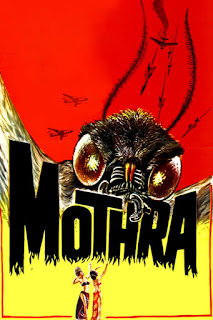
As the title so blatantly hints at, the monster in 1961's kaiju offering Mothra is a giant moth creature. Of course, monstrous here essentially relates to the creature's size, since Mothra is at least neutral if not outright benevolent towards humankind. It is the deity of a Polynesian island which had been considered uninhabited and even used for nuclear testing. That perception changes after the survivors of a Japanese ship run aground during a storm on this island are rescued and found to not be suffering the expected damage of radiation exposure. Not only does the island host a native tribal civilization, but they have concocted a red brew which seems to protect them from the radiation.
A joint expedition with leading scientists and explorers from Japan and the nation of Rolisica (a fictional country that seems to satirize the capitalist culture of the US) also discovers a pair of tiny singing women that are linked with a giant egg worshiped by the natives. Nelson, the Rolisican leader of the expedition, is played by Japanese-American actor Jerry Ito as a caricature of evil greed. Disregarding the "live and let live" policies of his Japanese colleagues, he grabs the little women (twins Emi and Yumi Ito of the pop band The Peanuts) with the intention of using them to make money as a showbiz attraction (like in King Kong).
In a mirror of US domination of Japanese policies, Nelson forcibly asserts his rights over the twins. His greed eventually leads to the hatching of Mothra from the giant egg. On a mission to restore the twins to their home on the island, the caterpillar form of Mothra swims its way to Japan causing much havoc both at sea and on land. it then forms a cocoon from which emerges the final form of the titular giant moth. Whether Mothra completes its mission and whether our Japanese heroes are able to persuade it to not attack humans in its course forms the rest of the film.
Although made by the same director (Ishiro Honda), Mothra differs in style from the seminal kaiju film, 1954's Godzilla/Gojira. Firstly it is in brash (Eastman?) color, not the black and white that gave a newsreel vérité quality to its predecessor. It has more cardboard heroes and villains, and is not as much about the conflict between nature and human progress as a good humans vs bad humans scenario. In the humorous relief (Frankie Sakai's cheeky reporter) and introduction of precocious child characters, it is also more geared to entertaining young audiences. All of these do make Mothra less impactful as a film than Godzilla was. That said it has some decent visual effects of the practical kind, and the very concept of a giant monster being serenaded with a weird song by tiny women tickles the imagination.
The 1992 film of Candyman is an iconic horror feature, one that - apart from the first Hellraiser film - comes closest to writer Clive Barker's trademark blend of romance / eroticism and horror; in its strongest moments it is simultaneously poetic and horrific. I admire the film so much I declined to see the much less well-regarded sequels. Apparently the original's director Bernard Rose was attached to a follow-up project sometime in the early 2000's, but that did not ultimately crystallize. When a new take on Candyman was announced a couple of years ago I was skeptical, but the presence of Jordan Peele (Get Out, Us) in the creative team was a major attraction. Peele is known for horror films built around quality writing, and his presence at least indicated that this would not be some idea-bereft VFX-showcasing cash-in on a known IP.
The 2021 film carries the same name as the original, but is not a traditional reboot. It is in fact a sequel that incorporates into its backstory the events of the 1992 movie and revisits the setting nearly 30 years later. Anthony (Yahya Abdul-Mateen II) is a painter working to make a presence in the art world, with the help of girlfriend Brianna (Teyonah Parris) who is an art curator. The film begins with them having shifted into a swanky part of the Cabrini-Greens neighborhood, and Brianna's brother Troy relates to them the events of Candyman 1992 as known to the public. Anthony jokingly invokes the Candyman summoning ritual, and shortly afterwards, strange and horrific events occur around him and his circle. Through the medium of the story, the film looks at the culture-stripping gentrification of minority neighborhoods, and also examines the art-world as a metaphor for racial integration in mainstream society. Candyman is represented as the collective (hive) spirit of the rage of a savaged / oppressed minority.
This does not mean that our Afro-American lead is enshrined in a golden halo. In fact, one of the early Candyman killings is of the gallery owner who wants to expel Anthony's work, and it is no secret that the artist is pleased with the reversal of his fortunes that comes in the aftermath of the murders. This change of fate is tied in with a physical transformation triggered by a bee sting (you definitely need to have seen the 1992 film to anticipate what this is leading to).
For me Candyman 2021 works a lot better on paper than as it unfolds on the screen. One of its problems is trying to depict a wide-ranging take on race prejudice within its fantasy universe in a very limited time-frame. The Candyman character is stripped off the intriguing ambivalence to a more outright sympathetic character. Also, too many of the supporting cast come across as exposition dumps. Yes, even the original Candyman had a lot of backstory reveal, but it was achieved in a more seamless fashion. Also this film over-uses the artistic device of paper puppets re-enacting the described events, as though the makers were not sure of the actors sufficiently holding attention with their lines. One of the best moments of Blackkklansman for me was when the Harry Belafonte character is describing a lynching - the event is presented solely through his retelling, and the scene is powerful because it asks the audience to imagine the event in their heads without distracting visual guides.
The film does get stronger in the climax, where it more fully realizes its potential of concomitant beauty and horror, but even here, it does not reach the heights of the original. Unlike Peele's previous films, Candyman 2021 relies too hard on the audience's memories of Candyman 1992 to play up the horror element in their heads, losing some of the majesty and mystique the previous film in favor of being a shrill social justice cry.
In Bheemante Vazhi, Bheema aka Sanjeev (Kunchako Boban) is a bachelor living in the village with his aged mother. After an incident in which he had to struggle through convoluted narrow lanes to get her to hospital, he takes on the mantle of getting a road through his neighborhood. This requires him to obtain permission from all the neighbors to allow part of their property to be used for the road, and adhere to the necessary bureaucratic protocols necessary to get the job done.
But the movie is not just about our hero achieving this task. It is also about his personal life - specifically, his outlook on sex and romance, and his phobia to commitment in a relationship. When the movie begins Bheema is in a regular sexual equation with a girl neighbor. When she gets a proposal, he is the one who smooths the way for her marriage, even if later he remarks to his BFF Maharshi (Chemban Jose Vinod) about the unemotional way in which women change partners. Later, he forms a deep mutual attraction with a Kannadiga railway engineer Kinnari (Megha Thomas). But when, prior to embarking on sex, she talks about marriage, he backs off immediately.
Bheemante Vazhi is remarkable in how liberated it tries to portray itself. Especially considering the insular rural setting, the attitude towards the female gender is incredibly forward. Except for one representative villain Kostheppu (Jinu Joseph) who makes lewd remarks at women AND puts various obstacles in the matter of the road-building, women are treated without prejudice. They can guzzle beer with the menfolk at the local bar or have casual sex without society chee-chee-ing them. It's a nice wish fulfillment exercise, even if it doesn't seem to mirror the reality of small town India (I would love to be corrected about this, if anyone has a perspective they want to share).
Bheemante Vazhi has a pleasant, unhurried beat and mostly likable characters. It however doesn't take enough trouble to keep the details of Bheema's mission interesting. Some of the technical and bureaucratic hurdles Bheema faces are not explained clearly and it became a little hard to comprehend the sequence of events in that regard. Problems arise and are sorted in a very deus ex machina fashion. The climax doesn't make much sense - if beating up the bad guy solves the legal problems, it could have been done a good while back. Also the manner in which the film resolves Bheema's Lothario status at the end ignores some of the beautiful character writing up until that point, and just feels cheap and random.
While not as well-worked out as it should have been, Bheemante Vazhi is, with sufficiently tempered expectations, a watchable enterprise.
Yosuke Fujita's movie Fuku-chan of Fukufuku Flats seemed like it could be an interesting entry in the laidback whimsical movie mold, like Katsuhito Ishii's The Taste of Tea, which I enjoyed a lot. The story revolves around Fuku-chan aka Fukuda (Miyuki Oshima), a shy and pudgy bachelor that lives in a blue-collar apartment complex and makes a living as a wall painter. Fukuda's single status is worrying his closest friend Shimacchi (Yoshiyoshi Arakawa) who keeps trying to arrange matches for him. These attempts are firmly rebuffed by Fukuda, otherwise an easy-going and good-natured person that quickly makes friends, even with decided oddballs like the neighbor with a python and another who is constantly visiting shrines as penitence for having once been a panty-stealer.
One day Fukuda meets the woman Chiho (Asami Mizukawa) who in the past had done him a wrong that scarred him for life, but is now determined to make amends for her mistake. The rest of the film is about how the friendship between Fukuda and the woman is gradually nurtured, and the change it brings into their respective lives and the people around them.
The ingredients are there for a modern Ozu-like feature with some surreal elements. But while The Taste of Tea captured a wonderful souffle like delicacy, Fuku-chan... falls below those heights; the relation between Fukuda and Chiho is handled with less skill, showing a more turgid sentimental touch, which never feels truly earned. Some parts, like the curry house episode in which they are almost murdered by the curry house owner simply because they asked for water to quench the hot curry, feel bizarre for bizarre's sake.
Still, most of the film is sufficiently watchable to recommend this on the whole as a relaxed one-time diversion. Curiously enough Miyuki Oshima, the lead actor playing Fukuda is actually a woman, with her hair cut really short and wearing men's clothes. Perhaps the director felt she had the right face for the part, even though she is not very convincing as a male.
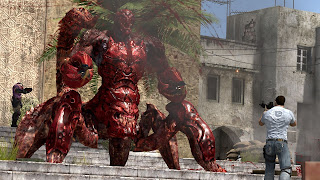
Having finally caught the Covid-19 infection, I have been in home isolation for the past few days, and after I got over the initial hump of fever, I felt sufficiently alright to do some PC gaming. After the idylls of GRIS I thought I would get into some mindless shooting of some alien bastards with 2012's Serious Sam 3: BFE. I had played a bit of SS3 after getting it at the time of release, but an early challenge area where I kept dying (I admit I have no skillz) made me put it back on the digital shelf. This time I started afresh, managed to get over that hump and move ahead. The first two Serious Sam games, imaginatively called First Encounter and Second Encounter, are among the most fun I've had in first-person shooters (FPS), with gorgeous wide open environments, kooky physics, silly wisecracks, chunky weaponry and a massive and varied bestiary to use it against. After the overly cartoony and gimmicky Serious Sam 2, this was supposed to be a return to roots for Sam Stone, Croteam's iconic weapon juggling parody of machismo.
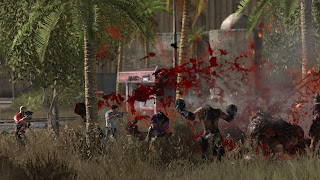
But I feel they went a little too far in dialing back the humor and color. SS3's first third is primarily set in a modern day battle-torn Egypt, which looks more like a Call of Duty environment with its bombed out buildings and razed streets (Later your character moves towards older ruins and eventually opens the timelock transporting him into the ancient Egypt setting of the first Sam game). More concerning is the introduction of weaponry with reloading and iron sights. Anyone that has played a Sam game before knows that the USP is to relentlessly blast one's way through large hordes of colorful enemies rushing towards you. Having to reload pistol and shotgun every 10 rounds, and the assault rifle every 20, is an onerous task in this type of game. Still worse, till more than 2/3rds into the game, ammo is scarce for weapons bigger than the shotgun(s) and the assault rifle. This means that for a long time, SS3 is more effectively played as a shooter in which the player hides behind cover and fires in short bursts. That's not inherently bad, but it makes the game feel more like a Serious Sam character mod for a Call of Duty game; even the trademark hilarious beheaded kamikaze bombers carry a more melancholic connotation in the warzone setting.
That said the more 'realistic' vibe did grow on me, and it helps that the technical aspects of the game are fine, and hold up well for a game that's nearly a decade old now. While I missed the more colorful vibe of previous games, especially Second Encounter's Aztec jungle shrines, Mesopotamian minarets and European hamlets, the art direction and the graphics of Serious Engine 3.5, at least on Ultra settings, have a consistent palpable quality that are a major step-up from previous versions of the game engine, including the one that powered HD remakes of the first two games. The particle effects from smoke and explosions are intense (so much so sometimes you can't see what you're shooting at, but hey, that's war). SS3 realizes that it is hard to make out pick-up items against the debris-littered background and helpfully borders them with color-coded glows (red for health, blue for armor, green for weapon and yellow for ammo).
It is mainly in the last third, after your character opens the timelock, that SS3 becomes *relatively* more free-handed with ammunition for the big guns (even here, the laser gun and the big cannon are underfed, and you rely mostly on the minigun, rocket launcher and remote explosives) and allows you the feel of the vintage Sam games. But the challenge ramps up all too quickly in comparison. While Sam has never shied away from an adrenaline pushing fight, the odds here are staggering. Add to that a greater number of enemies that can fire accurately from a large distance, while dodging your rockets, and two classes of airborne foes that are both hard-to-kill bastards - one of them is a Half-Life 2 helicopter inspired flying mutant who only responds to explosive damage, and the other is a tele-porting witch that can slow down Sam and deflect his aim while doing damage. When you have to deal with them in the middle of a showdown with a hundred other critters, it's a daunting prospect.
With regards to the last level, I will state here that could not complete it. I did not even reach the end-boss because the sheer volume of enemies in the way, combined with insufficient ammo for the ultimate weapons, made it outright impossible to get past without dying. Coming from someone who completed the previous Sam games, and found them fair even when tough, I have to wonder if this was play-tested for anyone below godlike shooter reflexes. It's sad, since the atmosphere of the game was brilliant at that point, with glorious combat music serenading as sun-rays flooded the massive canyon Sam is running through raising mayhem in the final leg. Checking on the net, I find that game reviewers (who normally are veterans that relish a challenge) are recommending to play this on Easy difficulty. Heck, for this last level, I dropped down to the so-called Tourist mode, which regenerates player health when not taking damage, and I still could not clear a way past the literal army of thousands beating down on me. It's a bitter pill to reach this far in a game and not be able to complete it, but fuck that, I have better things to do with the last dregs of my isolation period than beat my head against this (Sam) stone.

 Posts
Posts