Un-kvlt has become so much a movie opinions blog it is shocking to even myself when I add other content. But I have previously done game impressions so this is not entirely unheard of.
GRIS is one of the few video games where the end is a sad place to reach because you feel you could have stayed on a lot longer in the gorgeous world. You could take a screenshot just about anywhere in this surreal 2D platformer with light puzzle elements and it'd look like a frame-worthy work of art. The soundtrack is minimalist but very soothing and emotional in parts. Add to that a VERY forgiving learning curve - no dying, no hard boss fights, no requirement of super-fast reflexes and generally very intuitive puzzles - and I would recommend EVERYONE to try this out, even people who do not normally play video games.
More experienced gamers might deride this as a pretty but casual walking (with some jumping and swimming) simulator with barely any test of thumb dexterity, but I was certainly not complaining. The only place where I had a spot of trouble navigating was in an extended underwater labyrinth level where the visuals would sometimes zoom out so much I had to look for where my character was. But even there, taking a break for some time and then trying again, I was back on track.
Check out these screenshots I randomly took while playing to get an idea of how incredibly ravishing it looks. In motion it is even prettier when objects light up or make subtle motions in response to your actions. Moving your character around and discovering further wondrous areas of the game-world is a joy that transcends hitting the game goals or the acquisition of achievement trinkets.
Bali (Sacrifice) is the follow-up to director Vishal Furia's previous Marathi horror film Lapachhapi (Hide & Seek) [reviewed on this blog HERE]. Vishal's formula, if one may call it that for a 2-feature old maker (his third and most recent release Chhorii is a Hindi language remake of Lapachhapi), is to mix the chills with an underlying social message. Going into the specific details would be giving spoilers for those that have not seen them, so I will as much as possible refrain from doing so. What I liked most about Lapachhapi was its great location and atmosphere - Vishal has a real knack for identifying the inherent spookiness of an isolated / abandoned place and using simple but evocative visual framing ideas to allow the viewers to enhance it manifold in their heads. The best part of that film was the muscular middle-section showing a tantrik sequence where the protagonist appears to be trapped in a haze between reality and nightmare, not knowing which is which. The crafting of that sequence indicated a director with strong horror chops if he could control some of his other excesses, and it was with some anticipation that I sat down to Bali.
After a short prologue, Bali's main story begins with Srikanth (Swapnil Joshi) and his son Mandar (Samarth Jadhav). The opening moments are devoted to showing the close affection between the widower father and the little boy. Unfortunately, this is through cloying dialog and sentimental twaddle music that generates a sinking feeling about what lies ahead. Moving ahead, Mandar falls faint while playing cricket and is rushed by the father to the hospital, where incidentally he had been birthed.
Jansanjeevani Hospital (the name roughly translates as 'panacea for the masses') is where the bulk of the film is set. It is an old-style private-cum-charitable hospital setting with a closed-up disused wing, playing the same function of isolated eerie location as the remote sugarcane field in Lapachhapi. Once inside, Swapnila Gupta's script pulls out the corks on the weird stuff, as Mandar meets another child patient Bhaskar, who seems to move in and out at will, and claims to communicate with a nurse named Elizabeth who lives in the abandoned wing with the broken boarded-up windows.
This is also where the narrative becomes wobbly in credibility: The charming Dr. Radhika Shenoy (Pooja Sawant, returning from Lapachhapi) may radiate a caring attitude towards her pediatric wards, and is the daughter of the doctor that officiated Mandar's birth, but the fact that on his very first day in the hospital there are at least 3 instances of child patients, including Mandar, wandering off unattended and being found in strange places should have raised louder warning bells in Srikanth's mind. Even given that his financial difficulties may not give him a lot of choice about medical aid for his son, in an age where folks are ready to raise hell and bust a doctor's nose for any perceived negligence, Srikanth's wimpy acceptance of the "Oh hey, that kid's gone off again" situation in the hospital is strange. Perhaps the fact that Mandar was born there gives him a lingering attachment of familiarity and trust. Perhaps Dr. Radhika's charms are not restricted to her child patients alone. But the script does not trouble to give us ground for Srikanth's passivity.
It also does not sufficiently denote Srikanth's social circumstances. What does he do for a living? How does he manage work while at the hospital? Why does this amiable guy not seem to have any relatives / neighbors / friends to call upon? I am not a huge advocate for a story being explained to death, but there is an noticeable vacuum of context here. All we get is a lot of scenes where Srikanth implores Mandar to stay in his bed, while the brat (oh yes, that kid is annoying) whines incessantly about wanting to meet Elizabeth. These lapses in narrative are not sufficiently compensated for by the scare quotient. For seasoned horror fans, the clumsy cliches - like blood appearing on the hand-drawn map of the abandoned wing that Mandar gives Srikanth - generate more eye-rolling than dread. The whispery voices and glimpses of disfigured spooks passing from behind or reaching out have no freshness.
While not hugely enthralled, I did want to know where all of this leads to, and stuck out till the end. This eventually yielded benefits with one late scene showing dramatic character reveals and unveiling the cause of the eerie manifestations. There are also some important statements made about the modus operandi of hospitals and shady donation calls. While not as powerful as the aforementioned tantrik sequence from Lapachhapi, it is a heartening reminder of the maker's potential. Sad then, that it comes after so much empty noodling and is followed by a mundane finale.
Even with the lack of novelty, there's a decent story in Bali (and a hospital is a great horror setting - check out 1994's The Kingdom) A focused appeal to the sensitivities of horror buffs could have provided a well-made time-killer. But there are serious issues with the execution, subtlety being the biggest casualty. The incessant background score that seeks to underline every emotion only assaults the eardrums; Vishal would do better to trust his audience, and avoid such spoon-feeding. At the same time, the macabre element is anemic, and apart from that one late scene, there is little here that hasn't been done long before and to better effect.
As it stands, Bali does not live up to the ballyhoo.
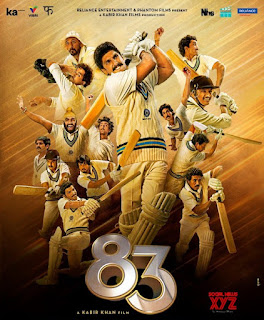
If despite all of Kabir Khan and his team’s missteps, ’83 - the story of how the Indian cricket team under Kapil Dev's captaincy went from being complete underdogs to reaching the finals and defeating champions West Indies (WI) to pick up the trophy and forever change the future of the sport in India - works as a sports drama, it is because of the incredible true story behind it.
The screenplay (Kabir Khan, Sanjay Puran Singh Chauhan and Vasan Bala) defines lack of focus. If they were trying to tell the story of India’s entire journey through the World Cup, it should have been an ambitiously mounted miniseries, India's answer to the Bodyline series, which we adored as kids. Or if they had decided to make a feature film, they should have done better than a collage of mostly rushed moments that do not give the epic build-up the narrative deserves.
For instance, they could have begun with the knockout match against Zimbabwe when India was at its ebb, and the manner in which Kapil almost single-handedly brought back the team from the brink of ignominious defeat, inspiring them to become the world-beaters they did. A gutsy film-maker would even have considered capturing the Zimbabwe game alone since it was also the sole unrecorded match in the '83 World Cup (due to the BBC being on strike that day, and most of the press being at the WI-Australia game). In the bid to cram in every match India played in that series, the games are reduced to highlights on steroids; there is no build-up or flow in their depiction.
Star Ranveer Singh makes an impact with his uncanny ability to absorb and emulate Kapil Dev’s persona. I must admit here that I am not per se a cricket fan, but as a kid the handsome toothy open-faced persona and flashy playing style of Kapil Dev would attract me enough to sit down to watch a cricket match. The two dialog scenes that really stood out for me are a) where Kapil vents about how the one thing that makes him angry is people’s lack of expectations from India, and b) when Krishnamachari Srikanth (Jeeva) gives a speech about the ‘mad’ captain who actually thought they had a chance to win this series when no one else did.
There are the occasional field action segments when the film takes a moment to focus, and provides some delights. The depiction of the Zimbabwe game, while still too truncated, gives a taste of what could have been. When Ranveer's Kapil gives us his iconic Nataraja pose while slamming the ball all across the ground (and smashing several window-panes and even windscreens of cars parked outside the stadium), it is hard not to feel goosebumps and lumps in the throat.
While it would be foolish not to expect a grand show of patriotic fervor in one of the country’s most significant sporting moments, there are scenes where this goes into puerile jingo: For example, the Indian team sitting in their bus after being thrashed by the Windies in their second encounter burst into happy tears seeing a lone Indian flag waved by a kid, and I am not sure the armed forces appreciate being represented as people who are caught unawares by shelling while glued to the radio for cricket updates. Even considering 80's hair, some of the wigs are awful, and there are some really cringy homages, like Mohinder Amarnath playing his own father Lala Amarnath, Kapil Dev playing a spectator cheering himself (what was that about?!), and a cloying reference to a child Sachin Tendulkar.
Thankfully the real life legend manages to overcome these glaring potholes and one is still glad that a new generation of Indians (and sports fans in general) can relive one of the great cricketing moments in Indian history, one that, beyond the sport itself, forged a nation more confident in its own worth.
Pauline is pretty, intelligent and thoughtful. Pauline listens more than she talks, and is less quick to judge than the people around her. Pauline is 15. The next installment in Eric Rohmer's Comedies and Proverbs series after The Aviator's Wife and A Good Marriage, Pauline at the Beach (PatB) is again an unhurried exercise in characters speaking on and on and, somewhere in that process, revealing a little of themselves.
Pauline (Amanda Langlet) is holidaying in a seaside town with her older cousin, the glamorous Marion (Arielle Dombasle). Marion has just finished with her divorce, and the beginning of the film is quizzing Pauline about her love life. Pauline reveals herself to be a blank slate, not yet marked by any serious "affaires de coeur". While at the beach (a frequent location justifying its name in the title), they come across Pierre (Pascal Greggory), a former lover of Marion who still worships her and would like nothing better than for her to accept him. But Marion is no longer interested in Pierre romantically (certainly not the burning passion she wishes to experience in love), and his petty jealousy only puts her off. She is aroused by Henri (Feodor Atkine), an older more worldly-wise man they ironically meet through Pierre. But Marion wants an old-fashioned passionate romance and fidelity, and Henri, with his nomadic roving nature may not be willing to give her that. Apart from the menage-a-trois, there's also the teen Pauline meets at the beach, who she likes enough to hang around with.
Based on the films I have seen above, Rohmer's special ability is to take the exaggerated emotional situations of his characters and put it through a light of realism that exposes the absurdity or pettiness of it while still not making caricatures of them. In PatB, this is less successful than in the previous pictures. I felt that the characters and situations were not as nuanced as the ones in The Aviator's Wife and A Good Marriage. This is most apparent in the section of the film where a misunderstanding occurs, inadvertently initiated by Henri and perpetuated by Pierre. It is a gauche device, that feels like it dropped in from some dated melodrama. To be fair, it is resolved in a quiet Rohmer-esque fashion (the last scene between Pauline and Marion is lovely), but it does stick out. Pierre's character is also half-drawn; his petty behavior makes it hard to ever appreciate his side of the story.
Of course, the main character here is Pauline, and as Amanda Langlet plays her under Rohmer's direction, comes off very well. We understand and appreciate Pauline as an intelligent adolescent girl who listens to several opinions, but ultimately goes by her gut feeling and makes her own decisions. She seems more balanced than the adults around her. On the whole a decent watch, but I am hoping for the further films in this series to be better.
Now that the year will be coming to an end in another week, 'tis time to continue the saga of movie opinions. I'm laying down my summarized views of 2021 movies I saw between Aug-Dec 2021 (My take on 2001 Jan-Jul movies HERE).
Shershaah (Hindi, Amazon Prime) As a film, this biopic comes off all too formulaic and pat, with the shallow feel of an overlong army recruitment promo rather than the emotionally involving saga of a brave warrior.
#Home (Malayalam, Amazon Prime) Shallow as an ad-film for a retirement finance plan, yet stretching to a vegetative 160 min, this one wallows in blandness. Too many characters introduced without giving them enough to do. The actors are almost uniformly solid (Indrans shines as the mild mannered indulgent father), but the script foundations are too weak and shaky for this #home to stand up. Site review HERE
Bell Bottom (Hindi, Amazon Prime) While the bulk of Bell Bottom suffers from Akshaykumarism and all that the syndrome implies, it's actually less of a wince-fest than the other movies he has done in recent past. There are occasional sequences where the film springs to life, holding true to its 70's Bollywood hailing spirit. With an actor who has less of an off-screen agenda this could have been a significantly more entertaining movie.
Aarkkariyam (Malayalam, Amazon Prime) Aarkkariyam may be described as a moral mystery with a warm humanist streak. The film errs on the side of rambling, but it is avoids unnecessary dramatics or that dreadful habit of superfluous twists that destabilize the narrative. Beautiful writing and performances make it worth recommending at least as a once-watch. Site review HERE
Shang-Chi (English, Hotstar) Up to about halfways, Shang-Chi and the Something Something was fakking boring. Even after that it never achieves greatness but Ben Kingsley has fun and the climax (with its nods to Return of the Jedi's father-son lighsaber duel) generates sufficient enthusiasm to meet the threshold for a boilerplate marvel feature.
A Ghost Waits (English) While the movie (which mixes elements of The Ghost and Mrs. Muir with Beetlejuice) was pleasant, it was never more than that. There is a sweetness to the romance element, but I felt the makers should have put more bite into the scare and humor segments and not have them be so timid / perfunctory as to be nondescript. Decent as a one-time watch (I saw it on the Arrow blu-ray).
Jai Bhim (Tamil, Amazon Prime) This is reminiscent of 90's Indian movies that mixed scenes of gruesome torture / violence with mainstream masala sentiment. The victims have little personality other than being innocent oppressed folks, and the bad guys are cardboard evil. For a film that so obviously fictionalizes many elements of its story, they could have tried to come up with more interesting writing.
Ghostbusters: Afterlife (English) Notable as my first post-lockdown cinema trip. This was a decent fun experience. It succeeds in keeping the fan service at a tolerable level and concentrating on giving likable characters (played by wonderfully cast young actors). It also, succeeds, without banging too hard on cheap references, to generate the sense of adventure Hollywood PG-13 movies had in the late 70's and 80's.
Still need to see (and would love to get more recommendations from y'all):
In Le Salaire de la Peur aka The Wages of Fear, an unnamed heat-drenched fly-infested South American town is home to drifters from around the world. These are washed-up, lonely men whose consolations are cheap liquor and small stakes gambling at the local watering hole. When newcomer Jo (Charles Vanel) schmoozes in with his spotless white suit and big goombah manner, he creates a stir and makes an instant crony of the local tough Mario (Yves Montand), the men linked by memories of a shared neighborhood in France and a sense of macho camaraderie. Indeed, as soon as Jo appears, Mario ditches both his barmaid girlfriend Linda (Vera Clouzot, H-G's wife of the time) and his loyal roommate the cherubic and loquacious Luigi (Folco Lulli); yes, fans of a certain video-game franchise will be tickled, more so since Luigi's appearance is very like the iconic animated mushroom-stomping plumber.
Every migrant in the town is looking for a chance to make some proper money and get out of there. This opportunity comes up when an US-owned oil company fighting a blaze at its local drilling site puts out a call for truck-drivers willing to deliver a large shipment of nitroglycerine that will be used to snuff out the fire. There are no safety measures available to cart this lethal cargo, which is why the company is recruiting anonymous drifters whose deaths no one will follow-up on. But for the princely sum of 2000$ apiece, these men are willing to take the risk. Two trucks, each manned by two drivers, set out to traverse the distance to the oilfields: Mario and Jo make one pair, while Luigi and the taciturn German expat Bimba (Peter van Eyck) form the other.
It takes about an hour of the film's running time to lead up to this scenario, but once the journey starts it is almost the sole focus of the rest of the narrative. The men must ride night and day to reach the site in time. Their cargo is sensitive to heat and vibrations. The terrain is rough; paradoxically the trucks must move quick over the rockiest bits to minimize the jolts (references to keeping the speedometer above a certain level to avoid an explosive jerk will remind 90's kids of a certain Keanu Reeves starrer). There are serious obstacles, including a rickety plank bridge, an immovable boulder that blocks the road and later, a lake of crude oil that truck and men must traverse.
The most interesting aspect of The Wages of Fear (based on a novel by Georges Arnaud) is the changing equation between its characters as they push forth in their hazardous course. Initially Jo is the heavy, the patron who twirls an eager Mario around his finger and bullies the other townsfolk with his revolver and his bravado. It is even suggested that he has 'eliminated' another fellow to be selected for the chance to earn the reward. But as the journey progresses, Jo's nerve gives way. He fidgets, he panics, he even tries to run away before he is dragged back by Mario, who grows increasingly disillusioned and contemptuous of the man he once deified. Both Vanel and Montand give their all to presenting the palpably credible transformation of their characters. In contrast Luigi, who had been earlier slapped around by Jo, throws off a cheerful courage and even the seemingly cold-hearted Bimba reveals an inner humanity. This is solid character drama wrapped around the mechanics of the tense suspense.
I do not agree with some of the criticisms leveled against Wages of Fear that the characters are shallow or that the film is unnecessarily bleak. Without spoiling events yes, it could have concluded on a more upbeat heroic note. But even if it is slightly overplayed in execution, there is nothing inherently wrong with the end as is, and it makes for a poignant conclusion for an equal parts thrilling and moving experience.
A few notes on my viewing experience:
More than a decade ago, a 148-min version of this film was released on blu-ray by the Criterion label (described on their site as a 'New, restored high-definition digital transfer'), and that release was good enough for the time. Some time in 2017, a new 4K restoration of an even longer (152-min) version of the film sourced from the original camera negative was carried out. The UK release from the BFI is based on this restoration (I understand they postponed their previous 2016 release plans to avail of the new master). As expected (see screenshot comparisons), it is dramatically superior to the Criterion blu-ray in terms of image clarity, grain resolution and a much more refined contrast/gray-scale. Simply put, even if you own the Criterion blu-ray, this is a must-have upgrade (unless you want to wait for a possible 4K UHD announcement).
The Wall here refers to the 1982 film adaptation of the phenomenal Pink Floyd album directed by Alan Parker. The script was written by the band's main rudder of that era, Roger Waters, and is partly autobiographical: The lead character, a rock star named Pink (a trans-continental phone call he makes refers to him as Mr. Floyd), who in the midst of a successful career is a drugs and alcohol addled recluse disconnected from the world around him. We go into Pink's past as a lonely child whose father died as a soldier in WW2. Between an over-protective mother and an uncaring educational system (compared here to a meat-grinding machine), Pink grows up so emotionally stunted he cannot hold on to any relationship, and becomes incapable of forming new ones. He seems to spend all his non-working time watching TV, specifically re-runs of the populist British war film The Dambusters (apparently a favorite of Waters)
Waters originally conceived The Wall as a cinematic extension of the album that would incorporate footage from the planned live performances and animation sequences by the brilliant Gerald Scarfe. That idea changed as development moved ahead. Once Alan Parker was attached to direct the project, he convinced the team to drop the idea of using any stage footage of the band, and commit to the reality of the film's setting. Originally Waters was to play the lead himself, but the job went to another musician Bob Geldof, who fully commits to the craziness of the part without any sympathetic concessions (apparently one of Waters' bugbears with the film, and at least partly responsible for a very acrimonious working relationship between him and Parker).
Going back and forth in time, and slipping fluidly between reality and dream, The Wall is like an feature-length music video (long before concept-oriented music videos were a thing). There are astounding juxtapositions of live action with Scarfe's nightmarish animated drawings; the most startling one is when a woman's shadow on the wall morphs into a monster that terrorizes Pink. It may be remembered here that this was long before CG was used to any meaningful effect in films, and achieved purely by a mix of practical and optical techniques.
Watching the film and hearing its soundtrack so many years after the last time I played the album, I once again came to appreciate the brilliance of The Wall as a work of art. The album's ubiquitous popularity has of course led to a bunch of people calling it overrated, and I won't deny getting a little sick of the number of times Another Brick in the Wall Pt 2 played on MTV, but once you've allowed a little distance, the emotional charge of Waters' lyrics and the band's fantastic musical sensibilities hit you right in the chest. Several critics have complained that the film is just a sensory showcase with little depth, but I felt that the emotional sub-text comes across well enough. I am not entirely sure of Pink's fascist fantasy in the last act of the film, but I did not find that a serious drawback, and between the lead acting (even Klaus Kinski would have had a pause at Geldof's crazy turn) and the constantly inventive chutzpah on display, the film remains interesting up to the end.
PS: The Wall is an interesting comparison to Tommy, another rock opera by a talented egoistic artist: Pink Floyd's album is more consistently brilliant, especially because it knows when to draw its curtains. Similarly, Parker's film adaptation of The Wall makes for a far more watchable and engaging experience than Ken Russell's "Let's fling all manner of shit and see what sticks" approach to the film of Tommy.

 Posts
Posts